
Is RSI Algo Trading Better Than AI Bots? A 2026 Comparison for Beginners
In 2026, the trading floor isn’t filled with shouting humans; it’s a quiet battle of silicon and scripts. If you’re a beginner entering this world, you’ve likely heard two terms thrown around like candy: Algorithmic Trading and AI Trading Bots. But when you look at actual profitability and control, many traders ask: Is RSI Algo Trading Better Than AI Bots?
When it comes to the classic Relative Strength Index (RSI), which path should you take? Is a rule-based RSI algo better than a “self-learning” AI bot? This guide breaks down the 2026 reality for retail traders who want to know why RSI Algo Trading is better than AI bots for building a disciplined, sustainable edge.
Is RSI algo trading better than AI bots for beginners?
“In 2026, RSI Algo Trading is better than AI bots for beginners because it offers “White-Box” transparency. Unlike AI bots that use complex, “Black-Box” neural networks, an RSI algo follows clear mathematical rules (e.g., Buy at RSI 30, Sell at 70). This makes it easier to backtest, cheaper to maintain, and significantly less likely to “hallucinate” or fail during unexpected market volatility.”
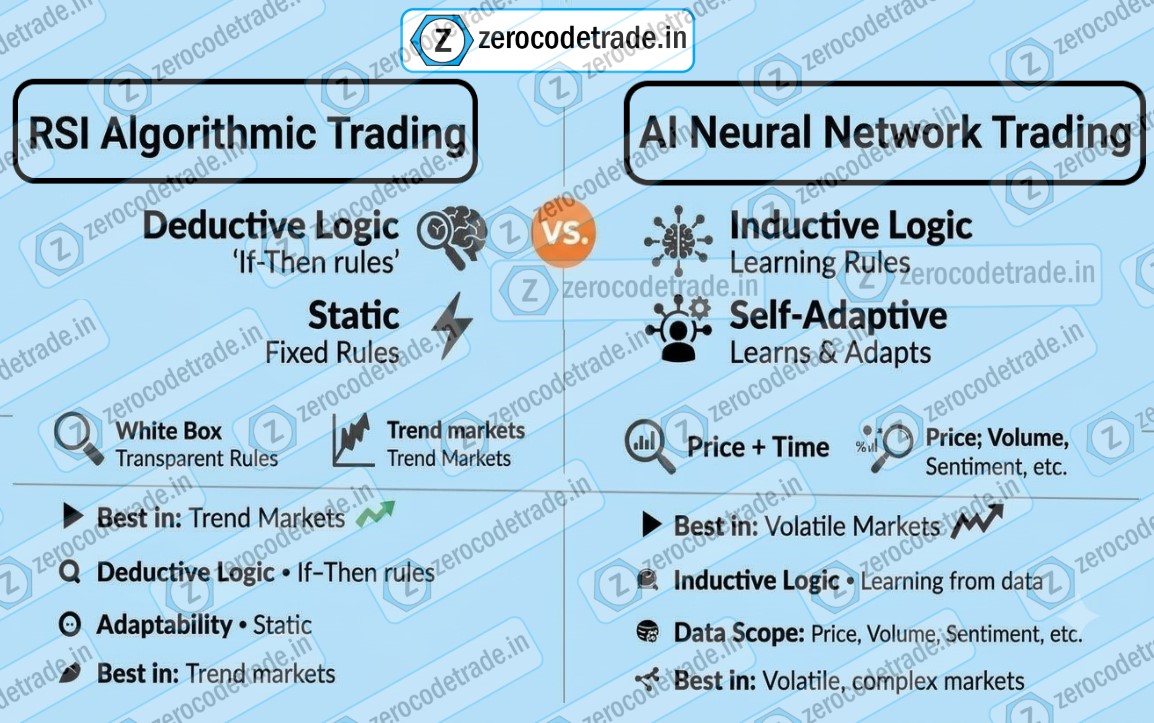
📺 Watch our Video explaining Is RSI Algo Trading better than AI Bots?
Author’s Advice & Important Risk Note
- High Risk Warning: Stock and options trading are high-risk endeavors that can result in significant financial loss. Before committing real capital to the live market, it is essential to start with backtesting, forward testing, and paper trading to validate your strategy.
- Do Your Own Due Diligence: Do not blindly trust any single broker, platform, influencer, or social media channel. The trading landscape is full of noise; your priority should be mastering the basics of market mechanics at your own pace.
- Educational Purpose Only: The insights shared on this website—including our analysis—are for informational and educational purposes only.
- Not SEBI Registered: We are not SEBI-registered advisors, and this content is not a recommendation to trade. Always perform your own independent research and testing before entering live markets.
1. The Great 2026 Trading Divide: Logic vs. Prediction
As we navigate 2026, the retail trading landscape has split into two distinct camps. On one side, you have Algorithmic (Algo) Trading, which relies on rigid, proven mathematical formulas. On the other, you have Artificial Intelligence (AI) Trading, which attempts to mimic human brain patterns to “predict” the future. If you are debating the difference between manual and algo trading, understanding this fundamental split is your most critical step.
For a beginner, the choice isn’t just about potential profit; it’s about control and understanding why RSI Algo Trading is better than AI bots in uncertain markets.
The Simplicity of the RSI Algo Strategy
The Relative Strength Index (RSI) has been a staple of technical analysis since 1978. In an automated “Algo” format, it acts like a high-speed calculator. It measures the velocity and magnitude of price movements. If the market moves too far, too fast (Oversold), the algo buys. It doesn’t wonder “why” the market moved; it simply reacts to the math. This deterministic approach is a core reason why many retail traders believe RSI Algo Trading is better than AI bots for risk management.
The Complexity of the AI Trading Bot
AI bots in 2026, often powered by Large Language Models (LLMs) and neural networks, do more than just math. They scan news headlines, listen to social sentiment, and analyze chart patterns. You can even read our guide on how to trade stocks using Grok AI to see how modern AI handles market analysis. However, while this sounds superior, it introduces a dangerous level of complexity that can lead to “Model Drift”—where the AI becomes less accurate over time as market conditions change.
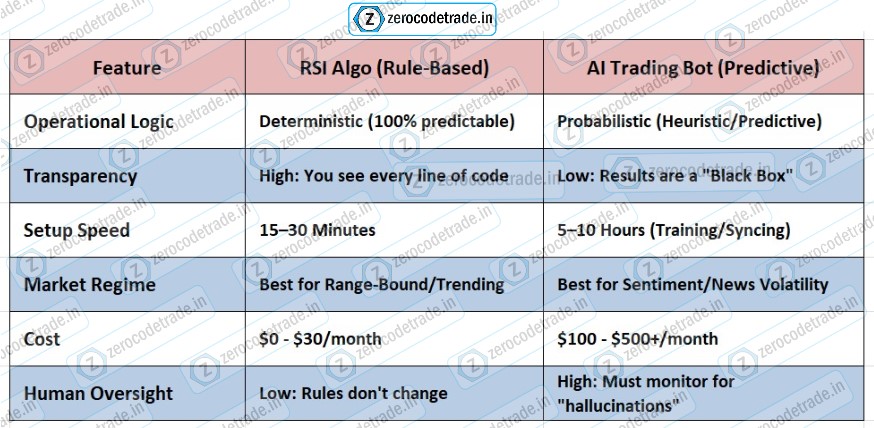
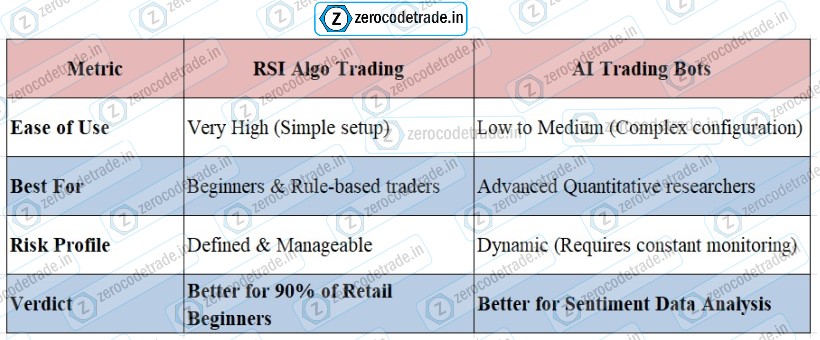
2. Detailed Comparison: Why RSI Algo Trading Is Better Than AI Bots
3. Key Reasons RSI Algo Trading Is Better Than AI Bots for Beginners
When evaluating Algo vs. AI trading for retail traders, a deeper look reveals why mechanical systems consistently outperform overly complex models for beginners.
3.1 The Transparency Advantage
In 2026, “Transparency” is essential for both trading discipline and SEO. When an RSI algo makes a trade, the underlying reason is instantly visible. You can look at the indicator, see it touched the “30” oversold level, and understand your entry point.
Why this matters for beginners: If you don’t understand why you won or lost, you aren’t trading; you’re gambling. AI bots often hide their reasoning inside neural weights, which makes it impossible for a new trader to learn the “rhythm” of the market. This operational clarity is a huge factor in why RSI Algo Trading is better than AI bots.
3.2 The “Over fitting” Trap in AI
AI is a “data-hungry” monster. To work, an AI bot must be extensively trained on past historical data. However, market cycles move faster than ever. An AI trained on previous market regimes might be completely useless during sudden macro shifts. This leads to Over fitting—where the bot finds patterns in historical data that were just random noise. Because the RSI uses a fixed mathematical formula, it doesn’t “try” to invent new patterns; it simply stays consistent.
3.3 Lower Infrastructure and Execution Costs
Running an AI bot requires massive computing power and expensive cloud infrastructure. If you review the overall cost of algo trading vs. AI trading, you’ll find that predictive tools require high monthly subscription fees or continuous API tokens.
An RSI algo, however, is a lightweight script. You can build and automate it effortlessly on popular automation platforms such as Streak by Zerodha, Tradetron, or test strategies on AlgoTest. You can also perform advanced technical analysis using TrendSpider.
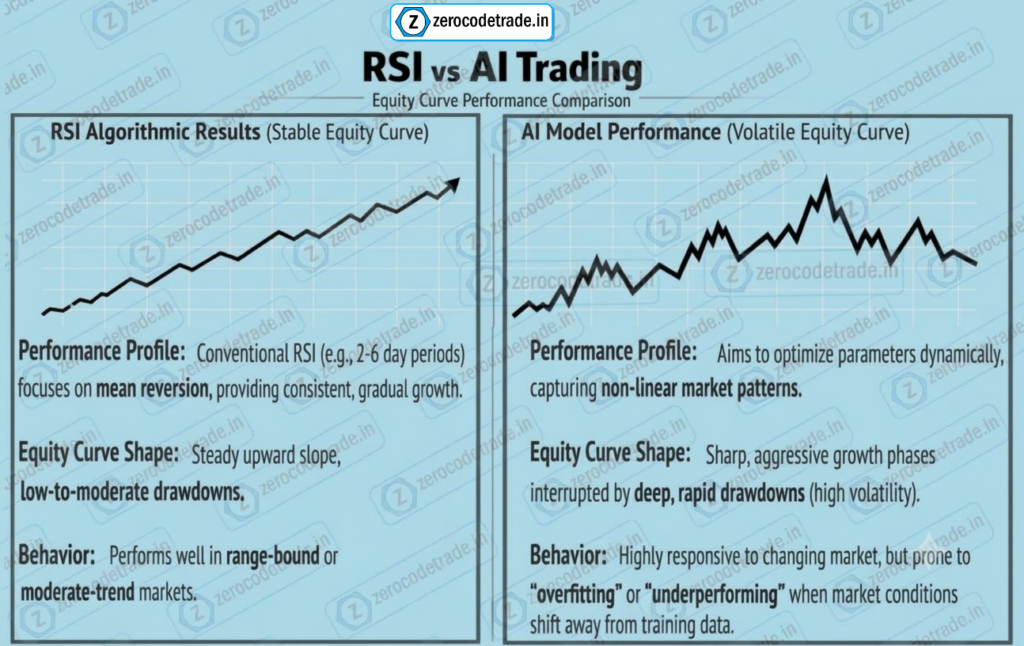
4. The “Hybrid” Strategy: Using AI to Support Your RSI Algo
You don’t necessarily have to choose only one tool. In 2026, the most successful retail traders use AI for market intelligence, but rely on rule-based RSI algos for order execution.
- The AI Step: Use tools like Grok or ChatGPT to analyze market context: “What is the current market sentiment for $TSLA? Are there any major news catalysts today?”
- The Algo Step: Once you confirm that the overall trend or sentiment is bullish, you activate your RSI Algo to find the precise oversold entry point without human emotion.
This hybrid workflow gives you the broad insights of AI while keeping the execution disciplined—further proving that for trade execution, RSI Algo Trading is better than AI bots.
5. Step-by-Step: How to Automate Your First RSI Strategy
To execute a clean, automated RSI strategy in 2026, follow this simple workflow:
- Choose Your Platform: Select a beginner-friendly no-code or low-code platform like TradingView (Pine Script), Tradetron, or Streak.
- Define Your RSI Levels: The standard setting is Buy at 30 and Sell at 70. For higher volatility, many traders adjust these to 25 and 75.
- Add a Trend Filter: Avoid trading RSI in isolation. Combine it with a 200-period Simple Moving Average (SMA). Only take “Buy” signals when price is trading above the 200 SMA.
- Connect via Webhook: Link your alerts via webhooks to send automated order signals directly to your broker.
- Backtest Before Live Trading: Test your setup on historical data using tools like AlgoTest. If the maximum drawdown exceeds 15%, refine your parameters before allocating capital.
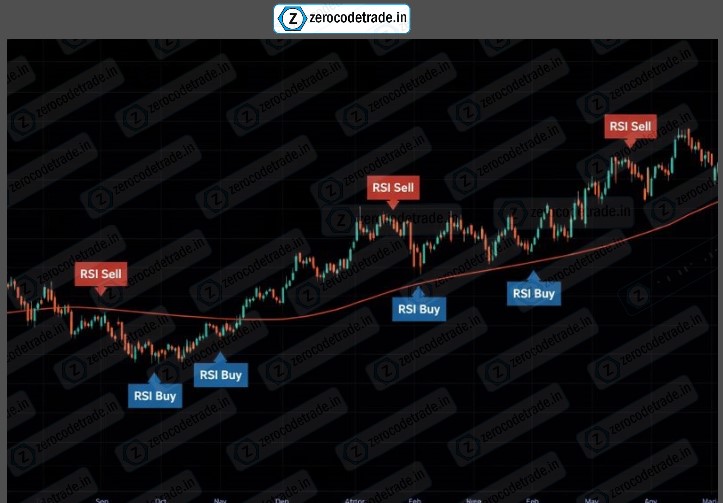
6. Common Pitfalls to Avoid with Automation in 2026
- Chasing “Black Box” Promises: Be cautious of vendors selling “Secret AI Bots” promising unrealistically high win rates. If a system sounds too good to be true, it is usually an aggressive marketing funnel.
- Ignoring Market Slippage: When an automated signal triggers, execution prices may differ slightly. Always factor in a 0.1% slippage buffer in your strategy calculations.
- Interfering During Drawdowns: Every mechanical strategy experiences losing streaks. Beginners often shut down a proven RSI algo after a few losses—stick to your backtested data and plan.
7.1 Frequently Asked Questions: RSI Algos vs. AI Trading Bots
Is RSI still relevant in 2026?
Yes. While market technology has accelerated, underlying human psychology (fear and greed) remains unchanged. The RSI remains one of the most reliable indicators for measuring momentum extremes.
Can AI replace standard RSI settings?
Some adaptive algorithms use AI models to dynamic adjust RSI boundaries (e.g., shifting oversold thresholds from 30 to 35 based on volatility). This can be a useful enhancement for advanced traders.
What timeframe works best for RSI automation?
For beginners, 1-hour or 4-hour charts offer the cleanest signals. Ultra-short timeframes (like 1-minute charts) are heavily impacted by institutional High-Frequency Trading (HFT) noise.
7.2 Advanced “Pro” FAQs
What is ‘RSI Divergence’ automation?
Instead of buying purely on oversold levels, a divergence algo looks for lower lows in price paired with higher lows on the RSI indicator. This setup often yields higher probability reversals.
How do I handle ‘RSI Ranging’ in strong trends?
In powerful trending markets, RSI can remain overbought or oversold for extended periods. Pairing your RSI with the Average Directional Index (ADX) helps filter out false reversal signals when trend strength is high (ADX > 25).
Why do retail traders find RSI Algo Trading better than AI bots in crypto markets?
Crypto trades 24/7 with high volatility. Simple RSI algos capitalize on sudden price spikes and sharp pullbacks consistently without suffering from the high server costs or model drift typical of AI bots.
8. Best Trading Tips for RSI Automation in 2026
- Apply the 80/20 Rule: In strong bull markets, price rarely dips to 30 RSI. Adjust your entry trigger to 40 so you don’t miss key continuation moves.
- Implement Trailing Stop-Losses: Instead of fixed exits, use an Average True Range (ATR) trailing stop to capture longer trends.
- Check Connection Health: Technical failures often stem from broker API disconnections rather than bad strategy rules. Verify your webhook connections daily.
- Enforce the 2-Indicator Rule: Always combine momentum indicators with a trend filter (like the 200-day moving average) to keep trades aligned with the broader trend.
- Start with Paper Trading: Test your automation with simulated capital for at least 2–4 weeks before committing live capital.
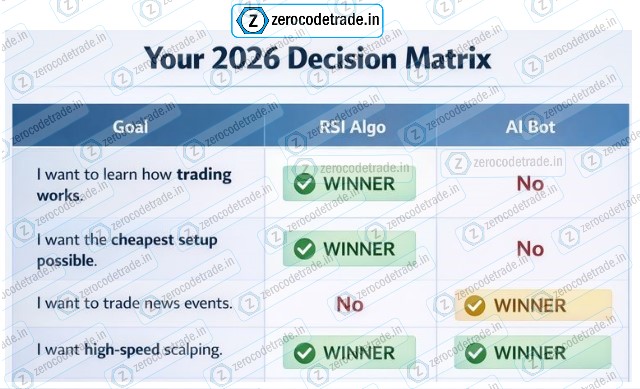
9. Summary Table: Your 2026 Decision Matrix
Final Thoughts
Don’t get blinded by marketing hype around AI labels. In the 2026 trading environment, consistency and risk management beat complexity every time. This is why RSI Algo Trading is better than AI bots for the vast majority of retail traders looking to build a sustainable edge.
Start with a simple, robust RSI automation, master your emotional discipline, and only incorporate advanced AI tools when your portfolio and market experience warrant it. Remember: the tool only executes the strategy—it never replaces trader discipline. Start small, risk a conservative portion of your capital per trade, and let rule-based execution do the heavy lifting.
Disclaimer
We are here to help you navigate the complex world of 2026 trading technology. While we provide insights on Algo trading, AI trading, AI tools, indicators, platforms, and suggestions, please understand that this is not financial advice, nor is it a recommendation to trade.
Trading involves significant financial risk. Automated tools are meant to assist your workflow, but they do not guarantee profits or provide a “magic button” for income. Always Backtest, Paper Trade, and Start Small to protect your capital.
Limitation of Liability: Zerocodetrade.in and its authors are not responsible for any financial losses, damages, or missed profits that may result from the use of the content, strategies, or third-party tools mentioned in this blog. All trading decisions are made at your own risk.

“Written by Laxmi Narayan — A stock trader since 2021, he has focused on merging traditional technical analysis with modern tools like Grok AI, ChatGPT to simplify and to educate about various trading patterns and styles, Laxmi shares his knowledge and insights for educational and informational purposes only.”