
Difference between manual and algo trading, the critical thing you need to know before trading
Algorithmic trading — or “algo trading” — has quickly become one of the biggest trends in the stock market. Instead of manually buying or selling shares, traders now use computer programs that automatically execute trades based on predefined rules.
In simple terms, the primary difference between manual and algo trading is that you tell the system what to look for, and when the conditions are met, the computer does the job for you — scanning charts, analyzing data, and placing orders within milliseconds. If you are just starting out, you might want to check out my guide on How to trade stocks using Grok AI: A Beginners Guide 2026 to see how modern AI tools are changing this landscape.
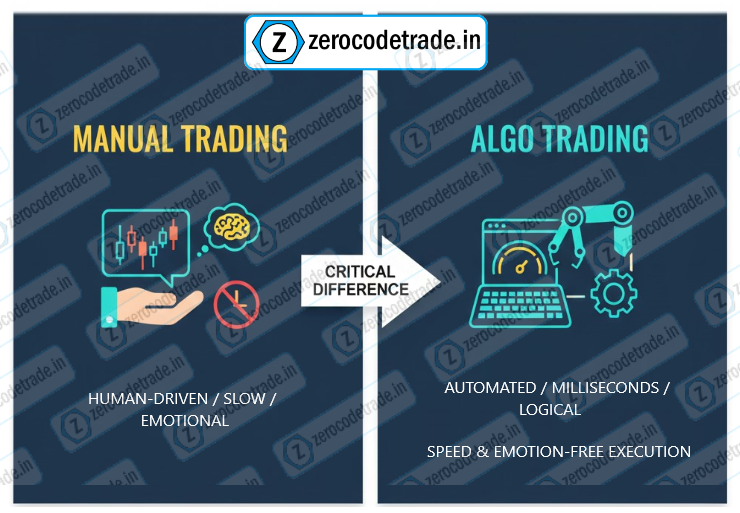
What is the critical difference between Manual and Algo trading?
The critical difference is execution logic and emotion. Manual trading relies on human decision-making, which is often slowed by emotional biases (fear/greed) and physical limitations. In contrast, Algo trading uses pre-programmed instructions to execute trades automatically at speeds impossible for humans. While manual trading allows for subjective “intuition,” algorithmic trading ensures discipline, consistency, and millisecond execution without human intervention.
Algo trading sounds powerful, right? It is. But just like every trading method, it comes with both strengths and risks. This guide breaks down the difference between manual and algo trading in a practical, simple, and honest way so you know exactly what you’re getting into.
📺 Watch our Video explaining Critical difference between Manual & Algo Trading:
Author’s Advice & Important Risk Note
- Stock and options trading are high-risk endeavours that can result in significant financial loss. Before committing real capital to the live market, it is essential to start with backtesting,forward testing, paper trading to validate your strategy.
- Do not blindly trust any single broker, platform, influencer, or social media channel. The trading landscape is full of noise; your priority should be mastering the basics of market mechanics at your own pace.
- The insights shared on this website—including our analysis are for informational and educational purposes only.
- We are not SEBI-registered advisors, and this content is not a recommendation to trade.
- Always perform your own independent research, testing before go live trading.
What Exactly Is Manual Trading?
While algo trading gets all the “high-tech” hype, manual trading remains the foundation of the financial world. Manual trading is the act of a human trader analyzing market data, charts, and news to make a personal decision to buy or sell.
In this setup, you use platforms like Zerodha Kite or Groww to physically place your orders. You are responsible for every step: from the initial research to the final exit.
How Manual Trading Works (The Human Flow)
- Analysis: You look at technical indicators or fundamental news (like earnings).
- Decision: You decide the entry price, stop loss, and target based on your “gut” and experience.
- Execution: You manually click “Buy” or “Sell” on your broker terminal.
- Monitoring: You sit in front of the screen, watching every tick of the price, which can be mentally exhausting.
The Power of Human Intuition
The biggest advantage of manual trading over its automated counterpart is flexibility. A human can look at a geopolitical event or a sudden CEO resignation and realize, “The charts don’t matter right now; I need to get out.” An algorithm, unless specifically programmed for that exact news event, might keep trading as if nothing happened.
What Exactly Is Algo Trading?
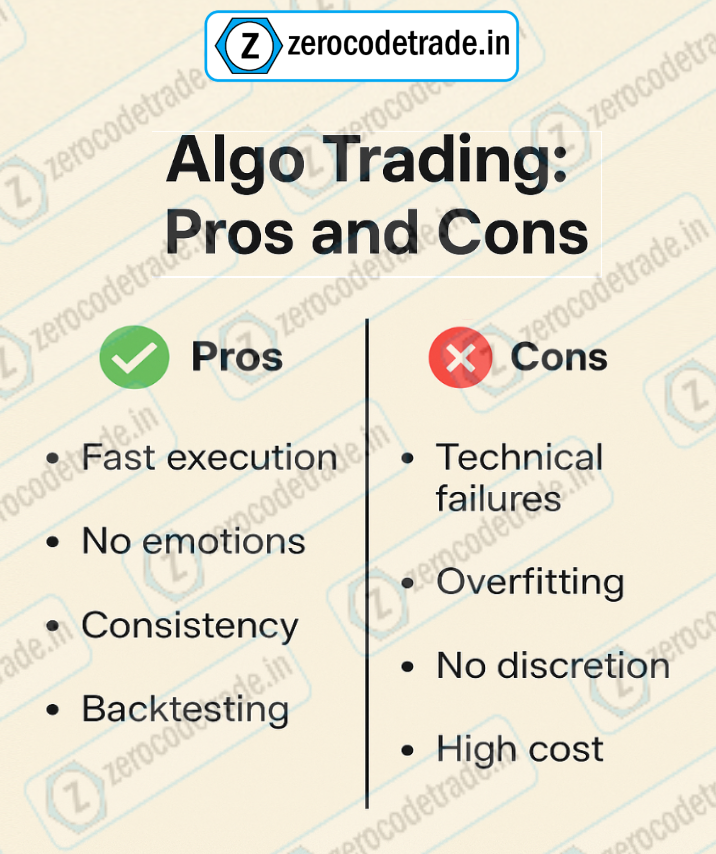
Algo trading is simply the automation of rule-based logic. You set conditions such as: “Buy XYZ stock if the price drops 2% below the 20-day moving average AND the volume increases.” Once met, the system executes instantly.
If you are confused about how this differs from high-end AI, read my deep dive on Algo vs. AI Trading: Which No-Code Automation Tool is Best for Retail Traders?
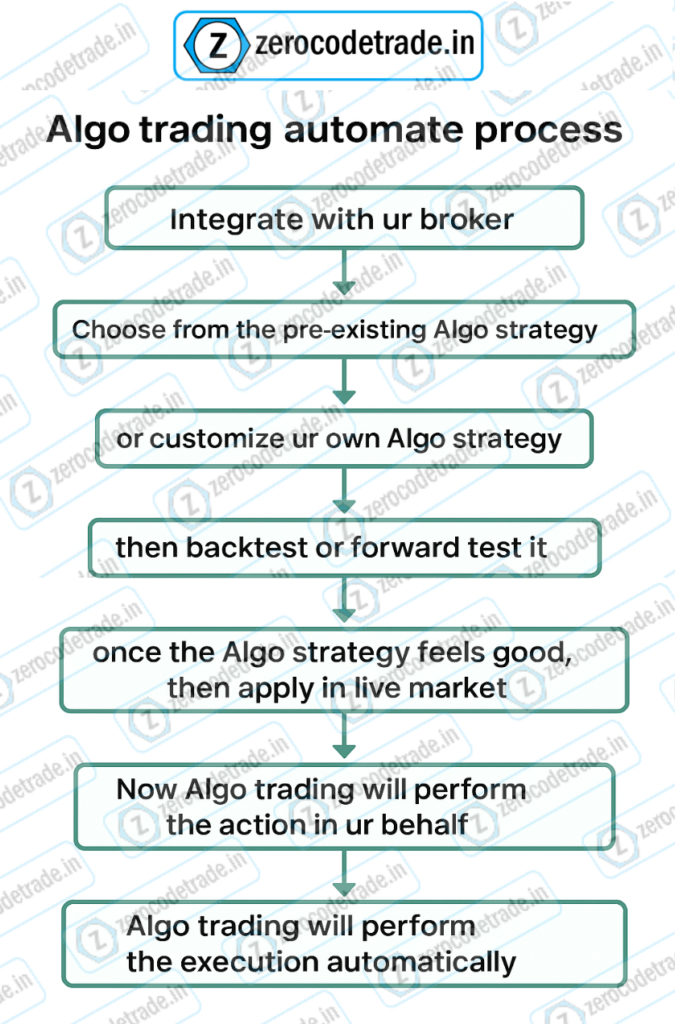
How Algo Trading Works (Simplified Flow)
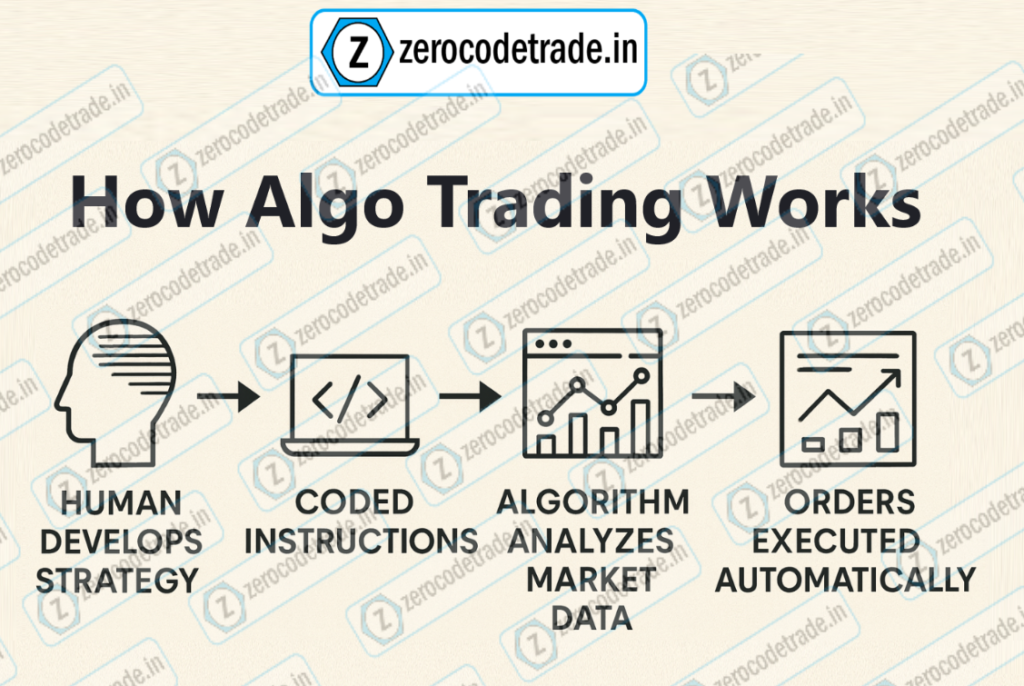
1. Define Strategy: You set the “If/Then” rules.
2. Data Feed: Market data enters the algorithm.
3. Condition Check: The system verifies if rules are met.
4. Execution: If “Yes,” the order is placed automatically.
5. Execution: If “No,” the system continues monitoring
Why It Works Better Than Manual Trading
A human can only watch a few charts at a time, whereas a computer can analyze hundreds simultaneously without fatigue. This efficiency is a core difference between manual and algo trading that gives tech-savvy traders an edge.
Deep Dive: The Positive Side of Both Methods
To understand the true difference between manual and algo trading, we must look at what makes each one “win” in specific scenarios.
Why Traders Still Choose Manual Trading
- Contextual Intelligence: Humans understand why a market is moving. If a “Black Swan” event occurs, a manual trader can pivot instantly.
- Low Barrier to Entry: You don’t need to know Python or pay for expensive API bridges. You just need a laptop and a broker account like Dhan.
- Creative Strategy: Humans are better at identifying “new” patterns that haven’t appeared in historical data yet.
Why Traders Are Moving to Algo Trading
- Lightning Speed: Algorithms capture price movements that last only a fraction of a second.
- Zero Emotion: It removes “Revenge Trading.” The computer doesn’t get angry when it loses money; it just waits for the next setup.
- 24/7 Monitoring: While you sleep, your bot can monitor international markets or crypto 24/7 without getting tired.
The Negative Side — Hidden Risks to Consider
Neither path is a guaranteed gold mine. Each has specific “failure points” that can drain an account.
The Struggles of Manual Trading
- Psychological Burnout: Watching a screen for 6 hours a day leads to “decision fatigue.”
- Inconsistency: You might follow your rules on Monday but break them on Friday because you had a bad day.
- Physical Limits: You cannot monitor 50 stocks at once; you will eventually miss a great opportunity.
The Technical Risks of Algo Trading
- Coding Glitches: A single “plus” sign where a “minus” should be can sell your entire portfolio by mistake.
- Overfitting: This is when a strategy looks amazing in a backtest but fails in real life. If you’re worried about the entry costs of setting these up, read my guide on the Cost of Algo Trading vs. AI Trading: Why Beginners Should Start with Rule-Based Bots.
- Connectivity Issues: If your internet or server goes down, your “Stop Loss” might not get triggered.
The “Hybrid” Approach: The Best of Both Worlds
The most successful modern traders realize that the difference between manual and algo trading doesn’t mean you have to pick just one. Many use a “Hybrid Model.”
How the Hybrid Model works:
- Manual Oversight: You identify the overall market trend (e.g., “The market is bullish today”).
- Algo Execution: You turn on a specific “Trend Following” bot to handle the entries and exits with precision.
- Manual Kill-Switch: If unexpected news hits the wires, you manually shut down the bot to protect your capital.
Why Traders Love Algo Trading
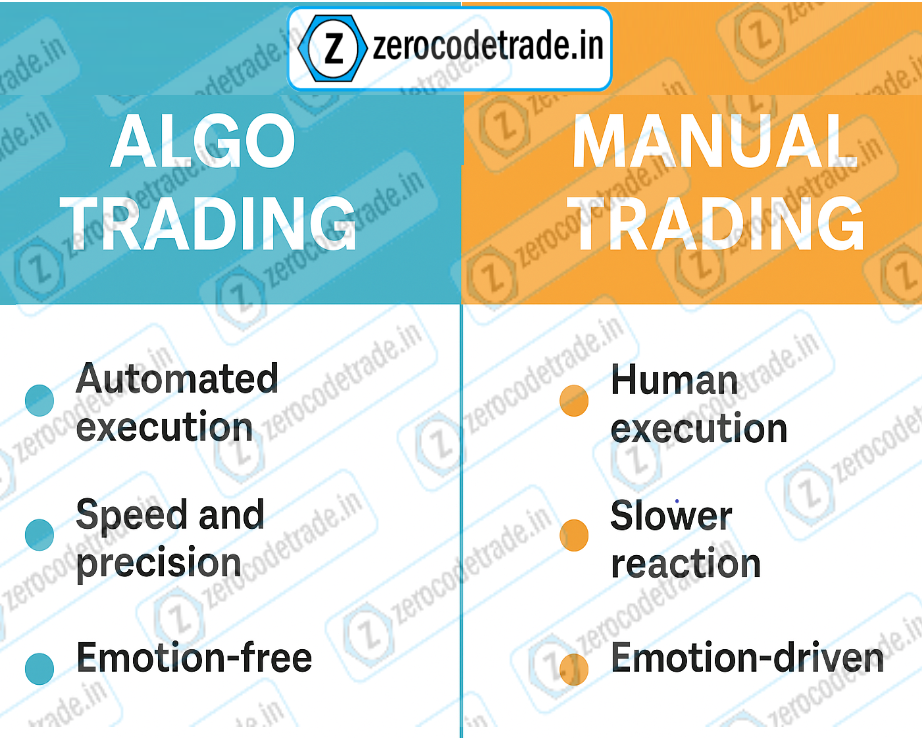
Algo trading isn’t popular by accident. Here are the biggest real-world advantages:
1. Lightning-Fast Execution
Algorithms react in microseconds. Opportunities that vanish in the blink of an eye can still be captured, which is impossible in a manual setup.
2. More Accuracy, Zero Emotional Bias
By removing fear and greed, trades are executed exactly as planned. This discipline is often the biggest difference between manual and algo trading results for retail investors.
3. Consistency & Discipline
No fatigue.
No overtrading.
No second-guessing.
The algorithm follows the rules with perfect discipline — a major advantage for traders who struggle with consistency.
The Hidden Risks of Algo Trading
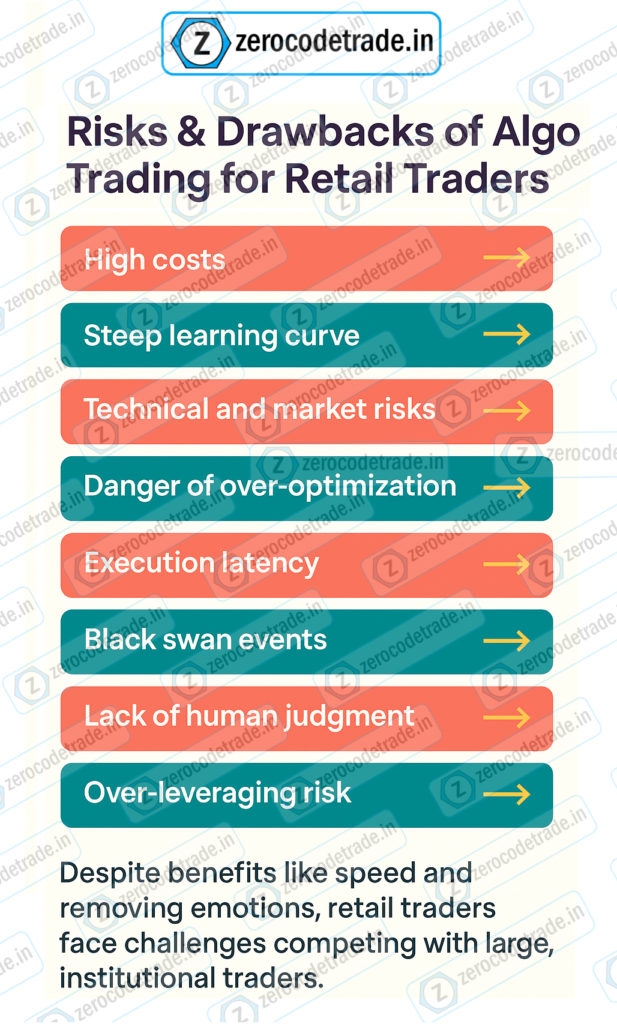
Algo trading is powerful — but far from perfect. Understanding the risks is critical.
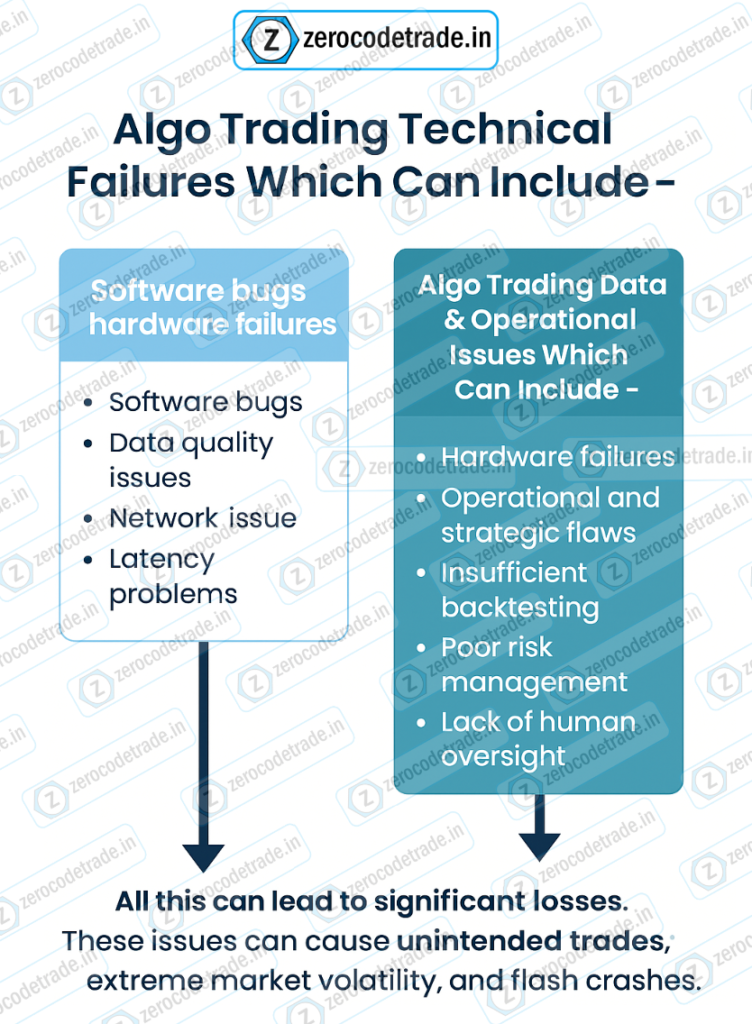
1. Technical Failures Can Be Costly
A minor coding error or a server crash can trigger unintended trades, leading to massive losses in seconds.
Common issues include:
- Coding errors
- Server crashes
- Platform downtime
- Unstable internet
- Misfiring signals
2. Overfitting: When a Strategy Looks Good Only on Paper
Many traders “tune” their strategies too perfectly to past data. It looks great in a backtest but fails in the live market because yesterday’s conditions rarely repeat perfectly.
Overfitting is one of the biggest reasons retail Algo traders fail.
3. No Human Judgment During Sudden News Events
Algorithms do not understand:
- surprise news
- geopolitical events
- earnings reports
- emotional market reactions
When the market behaves irrationally, algorithms may react in unpredictable or harmful ways.
Comparison Table — Difference Between Manual and Algo Trading
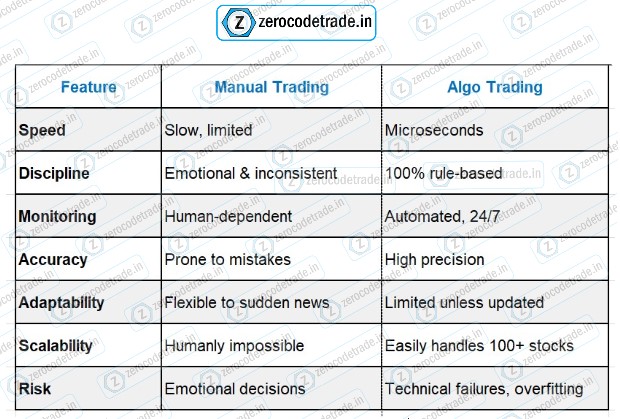
While comparing difference between Manual and Algo trading which one is 100% Profitable
No. Neither method guarantees profits. While Manual Trading relies on human judgment and news interpretation, Algo Trading wins on precision and volume.
Manual Trading Advantages:
- Human judgment
- Ability to interpret news
- Flexible during sudden changes
Algo Trading Advantages:
- Speed
- Precision
- No emotions
- Ability to handle multiple stocks
The Winning Approach:
Most successful traders use a hybrid approach:
Automation for efficiency + human oversight for judgment.
Frequently Asked Questions (FAQ)
General Questions
Is Manual trading more profitable than Algo?
Not necessarily. Manual trading allows for higher returns during volatile, news-driven markets where intuition counts. Algo trading wins in “sideways” or “trending” markets where consistency and volume are key.
Can a beginner start with Algo trading immediately?
Yes, using “No-Code” platforms like Streak. However, you should still understand the manual logic first. If you don’t know why a trade should be made, you won’t know how to fix a broken algorithm.
What is the biggest risk in Manual trading?
The “Human Element.” Most manual traders lose money because they exit winners too early out of fear and hold losers too long out of hope.
Do I need a supercomputer for Algo trading?
No. Most retail traders in 2026 use cloud-based VPS (Virtual Private Servers) so their logic runs even if their home computer is off.
Advanced “Pro” FAQs
What is “Latency Arbitrage” in Algo trading?
This is a professional strategy where bots exploit the tiny time differences (milliseconds) in price updates between different exchanges. It is impossible to perform manually.
How does “Slippage” differ between Manual and Algo?
In manual trading, slippage occurs because of human reaction time. In Algo trading, it usually occurs due to high market volatility or poor server proximity to the exchange.
What is a “Kill Switch” in automated systems?
A pro-level safety feature. It is a master script that automatically closes all positions and stops the bot if a specific drawdown percentage (e.g., 5%) is hit in a single day.
Can Algo trading handle “Black Swan” events?
Generally, no. Algos are based on historical patterns. When a “one-in-a-million” event happens, manual traders are often better at stepping in to stop the systems before they drain the account.
Expert Trading Tips: Manual vs. Algo
1. The 10% Rule for Beginners
If you are transitioning from manual to algo, do not move your whole portfolio. Start by automating 10% of your capital. This allows you to learn the technical “quirks” of automation without risking your entire nest egg.
2. Use “Paper Trading” for 30 Days
Never go live with an Algo bot immediately. Most platforms (like TradingView or MetaTrader) allow you to run the bot with “fake money” in real-time markets. If it can’t survive 30 days of paper trading, it won’t survive the live market.
3. Manual “Market Regime” Filtering
The best traders use a hybrid approach. Manually identify the “Market Regime” (Is it trending or sideways?). Then, turn on the specific Algo bot designed for that environment. Don’t expect one bot to handle every market type.
4. Master the “Backtest” Metrics
Don’t just look at “Total Profit.” Look at the Max Drawdown and Profit Factor. A bot that makes 100% profit but had a 90% drawdown is a ticking time bomb.
Conclusion
The difference between manual and algo trading isn’t about which one is “better”—it’s about which one fits your personality.
If you love the thrill of the hunt and have strong emotional control, manual trading is a beautiful craft. If you prefer logic, math, and want to remove the stress of decision-making, algo trading is a powerful tool. In the modern era, the most profitable traders are those who can navigate both. Think of algorithms as your high-speed assistants, but remember: you are still the pilot.
Disclaimer
We are here to help you navigate the complex world of 2026 trading technology. While we provide insights on Critical difference between Manual and Algo trading and suggestions, please understand that this is not financial advice, nor is it a recommendation to trade.
Trading involves significant financial risk. Automated tools are meant to assist your workflow, but they do not guarantee profits or provide a “magic button” for income. Always Backtest, Paper Trade, and Start Small to protect your capital.
Limitation of Liability:The Zerocodetrade.in and its authors are not responsible for any financial losses, damages, or missed profits that may result from the use of the content, strategies, or third-party tools mentioned in this blog. All trading decisions are made at your own risk.

“Written by Laxmi Narayan — A stock trader since 2021, he has focused on merging traditional technical analysis with modern tools like Grok AI, ChatGPT to simplify and to educate about various trading patterns and styles, Laxmi shares his knowledge and insights for educational and informational purposes only.”