
Cost of Algo Trading vs. AI Trading: Why Beginners Should Start with Rule-Based Bots
Choosing between rule-based automation and artificial intelligence (AI) is the most critical financial decision a new trader will make in 2026. While AI is the “shiny new object,” the cost of algo trading vs AI trading remains the deciding factor for most. The high cost of entry and the risk of “black-box” errors make rule-based bots the superior starting point for retail beginners.
If you are just starting out, you might want to check out my previous guide on How to trade stocks using Grok AI: A Beginners Guide 2026, but today we are diving deep into the financial side of automation.
Is Algo trading cheaper than AI trading?
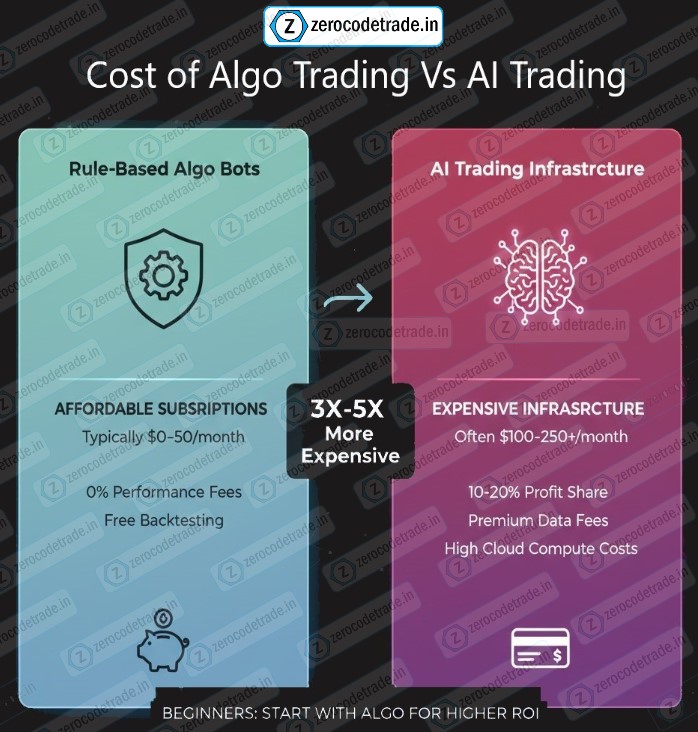
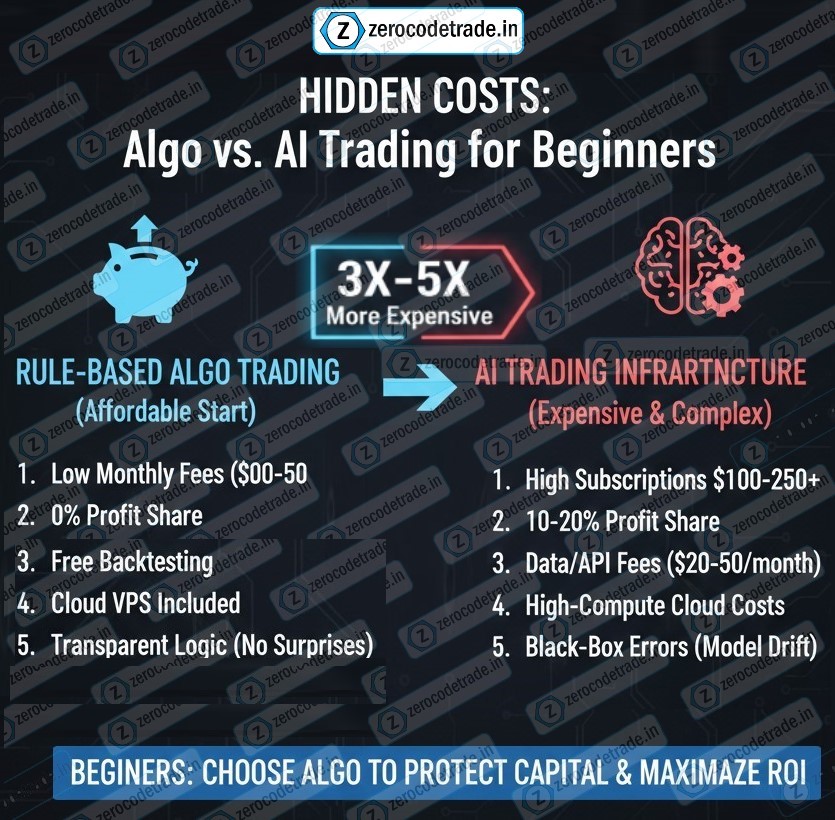
Yes. For retail beginners in 2026, Rule-Based Algo Trading is significantly more cost-effective. Subscriptions typically range from $0 to $50/month, with zero “performance fees.” In contrast, when comparing the cost of algo trading vs AI trading, AI often requires premium subscriptions ($100+/month), specialized data licenses, and frequently carries a 10-20% profit-sharing fee. This makes the total cost of ownership 3x to 5x higher than simple algorithmic bots.
📺 Watch our Video explaining why Beginners should start with Rule based Bots:
Author’s Advice & Important Risk Note
- Stock and options trading are high-risk endeavours that can result in significant financial loss. Before committing real capital to the live market, it is essential to start with backtesting,forward testing, paper trading to validate your strategy.
- Do not blindly trust any single broker, platform, influencer, or social media channel. The trading landscape is full of noise; your priority should be mastering the basics of market mechanics at your own pace.
- The insights shared on this website—including our analysis are for informational and educational purposes only.
- We are not SEBI-registered advisors, and this content is not a recommendation to trade.
- Always perform your own independent research, testing before go live trading.
What is Algo Trading?
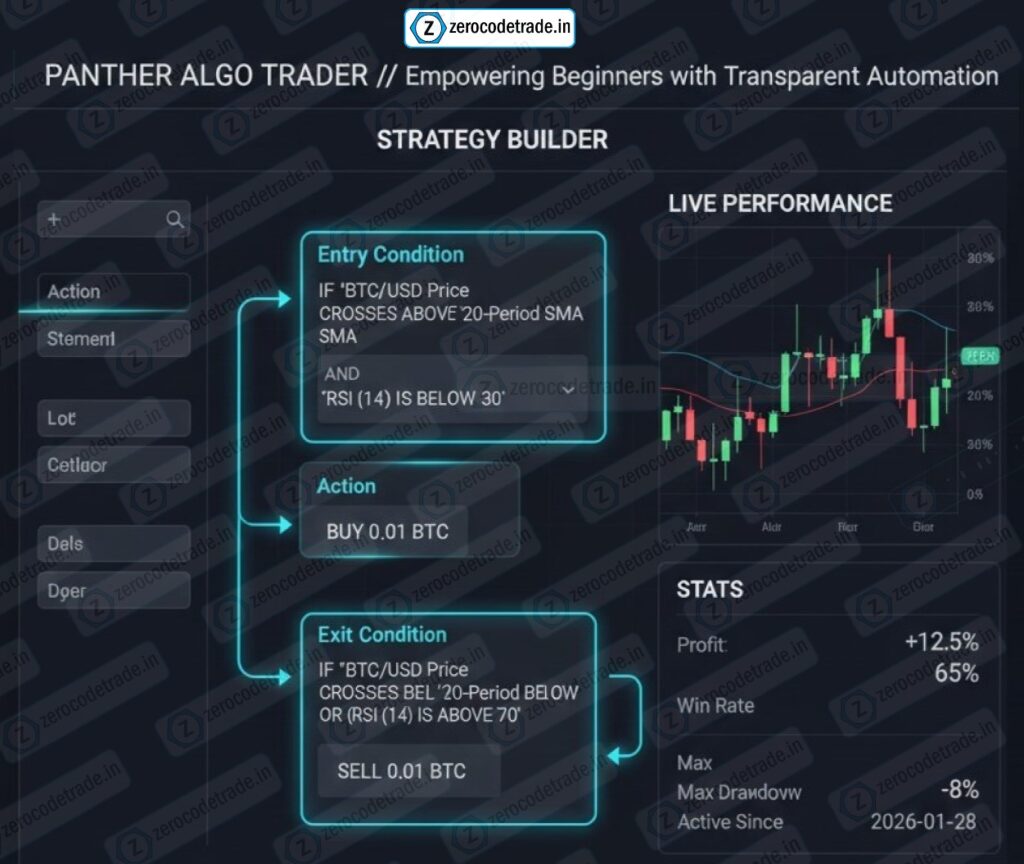
Algo trading uses predefined rules to automate buy/sell decisions, like “buy if price crosses 50-day moving average.” It’s deterministic and transparent. Beginners love its simplicity—no machine learning needed.
Before committing to a strategy, it is vital to understand Manual vs Algo trading: the critical difference you need to know. Rule-based bots execute trades based on if-then logic. They run on platforms like TradingView or Python scripts. Because the cost of algo trading vs AI trading is so lopsided in favor of Algos, you can keep your overhead low by coding basic strategies yourself.
Understanding AI Trading
AI trading employs machine learning models like neural networks to predict markets from vast data. It adapts but requires massive datasets and computing power. While powerful, many wonder: is the high cost of algo trading vs AI trading justified for a small account?
Models like LSTM analyze patterns proactively. However, black-box decisions make debugging hard. High data needs mean cloud GPU rentals add up fast. If you are debating which software to buy, see my breakdown of Algo vs. AI Trading: Which No-Code Automation Tool is Best for Retail Traders?.
Key Differences
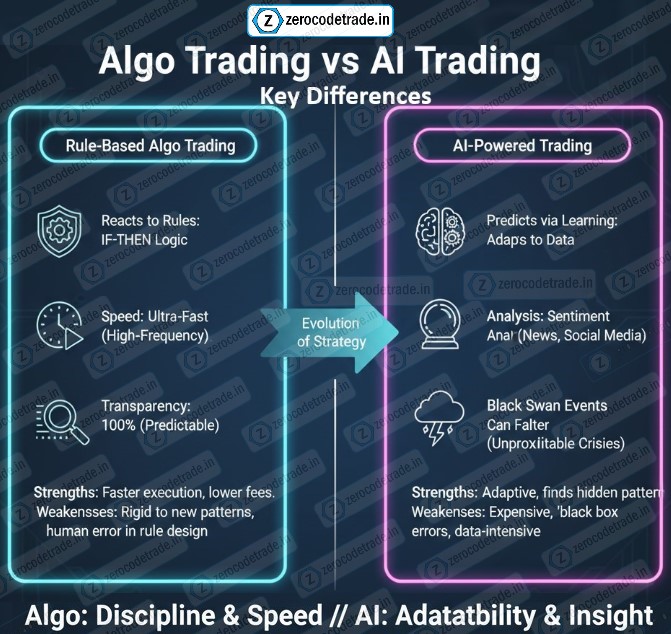
Algo trading reacts to rules; AI predicts via learning. Rule-based is faster for high-frequency trades. AI shines in sentiment analysis but falters in black swan events.
1. The 2026 Trading Landscape: Price vs. Performance
In 2026, the retail market is flooded with “AI-powered” bots promising 24/7 market adaptation. However, for a beginner with a capital of $1,000–$5,000, fixed costs are the enemy. If your bot costs $150 a month to run, you need a 15% monthly return just to break even on the software. This is why the lower cost of algo trading vs AI trading makes “Rule-Based” bots the gold standard for those starting their automation journey.
The “Hidden Tax” of AI Trading
AI bots in 2026 often operate on a SaaS + Commission model. While you might pay a base fee, many providers now charge a “Success Fee.” If the AI makes you $1,000, they take $200. Rule-based bots (like Tradetron or Coinrule) generally follow a flat-fee model, allowing you to keep 100% of your hard-earned alpha.
2. Detailed Cost Comparison: Algo vs. AI
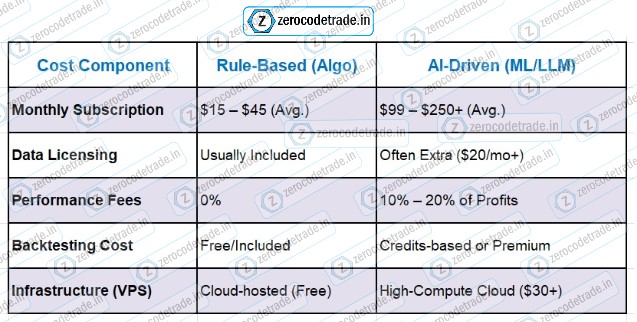
The following table highlights the primary differences in the cost of algo trading vs AI trading:
2.1 Why AI Costs More: The Compute Factor
AI isn’t just a marketing term; it requires massive computational power. In 2026, running a “Neural Network” that scans social media sentiment, order flow, and technicals simultaneously requires high-end GPUs. Platforms pass these Cloud Compute Costs directly to the user. Rule-based bots run on simple “If-Then” logic that costs almost nothing to host, keeping your overhead low.
3. Transparency: The “Invisible” Cost of AI Hallucinations
One of the most dangerous costs for beginners isn’t a fee—it’s logic failure. When evaluating the cost of algo trading vs AI trading, you must consider the cost of errors:
- Algo Bots: You know exactly why a trade was taken (e.g., “RSI was below 30”).
- AI Bots: The AI might “hallucinate” a pattern in a low-liquidity stock, leading to a massive “Fat Finger” error.
In 2026, many retail traders have reported “Model Drift,” where an AI bot trained on 2025 data fails to recognize a 2026 market regime shift, leading to unforced drawdowns.
Why Beginners Should Choose Rule-Based Bots
Start simple: Code a moving average crossover in Python (free). Backtest on historical data, go live with paper trading. Build confidence without debt.
Low barrier: Platforms like Streak or Amibroker cost under ₹500/month in India. The favorable cost of algo trading vs AI trading allows you to scale to AI later using only your profits.
Getting Started Steps
- Learn Python basics (free Codecademy).
- Pick broker like Zerodha (low fees).
- Code first bot: RSI <30 buy, >70 sell.
- Deploy on VPS ($5/month).
- Monitor weekly, tweak rules.
Best Trading Tips for 2026 Beginners
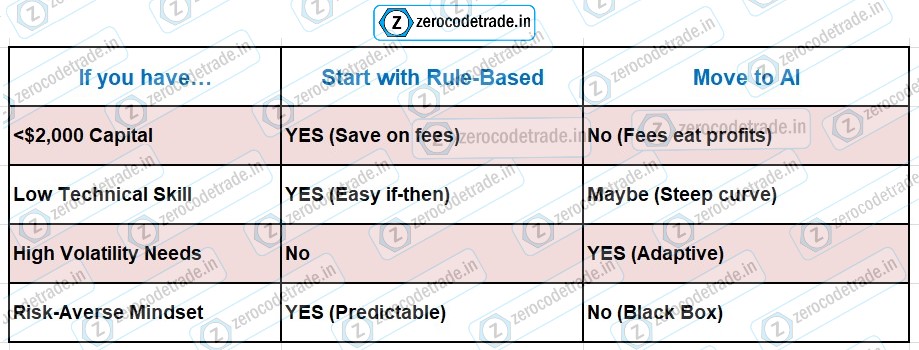
- The 1% Rule: Never let your monthly bot subscription exceed 1% of your total trading capital. If you have $2,000, don’t pay more than $20/month for software.
- Focus on Slippage: In 2026, execution speed (latency) is a bigger cost than the subscription. Choose bots with Direct API access to your broker.
- Audit Your AI: If you use an AI bot, “Retrain” your model monthly. Market patterns in 2026 expire faster than they did in the 2020s.
Frequently Asked Questions (FAQ)
General Questions
Can I start algo trading for free?
Yes. Platforms like Pionex offer built-in rule-based bots (Grid/DCA) for free, charging only standard trading fees.
Is AI trading always better than Algo?
No. In “Sideways” or “Ranging” markets, simple Algo bots usually outperform AI because AI tends to over-analyze and “overtrade” in low-volatility environments. When you factor in the cost of algo trading vs AI trading, the simpler bot often nets a higher profit after fees.
What is the best “Starter” bot?
For stocks, Tradetron; for crypto, Coinrule.
Advanced “Pro” FAQs
What is “Overfitting” in AI costs?
This is the cost of time. Traders spend hundreds of hours (and subscription dollars) tweaking an AI to fit past data, only for it to fail in live markets. Algos are less prone to this.
Does “Server-Side” execution save money?
Yes. By using bots that execute on the cloud rather than your local PC, you avoid “Slippage” costs caused by internet lag.
Summary Table: Where Should You Invest Your Money?
Conclusion
The “Allure of AI” is strong, but the Math of Algo is stronger for beginners. In 2026, the key to surviving your first year of automated trading is overhead control. By choosing rule-based bots, you minimize your monthly “burn rate,” giving your strategy the time it needs to grow without the pressure of high-ticket subscriptions.
Start simple. Master the rules. Then—and only then—let the AI take over.
Disclaimer
We are here to help you navigate the complex world of 2026 trading technology. While we provide insights on cost of algo trading vs AI trading platforms and suggestions on which no-code platforms and AI tools are currently leading the market, please understand that this is not financial advice, nor is it a recommendation to trade.
Trading involves significant financial risk. Automated tools are meant to assist your workflow, but they do not guarantee profits or provide a “magic button” for income. Always Backtest, Paper Trade, and Start Small to protect your capital.
Limitation of Liability:
The Zerocodetrade.in and its authors are not responsible for any financial losses, damages, or missed profits that may result from the use of the content, strategies, or third-party tools mentioned in this blog. All trading decisions are made at your own risk.

“Written by Laxmi Narayan — A stock trader since 2021, he has focused on merging traditional technical analysis with modern tools like Grok AI, ChatGPT to simplify and to educate about various trading patterns and styles, Laxmi shares his knowledge and insights for educational and informational purposes only.”