
How to Automate a Manual RSI Strategy: An Easy Beginner’s Guide for 2026
For decades, the Relative Strength Index (RSI) has been the “bread and butter” of manual traders. You wait for the line to dip below 30, you buy; you wait for it to cross 70, you sell. It sounds simple, but in the fast-paced markets of 2026, the biggest obstacle to profit isn’t the strategy—it’s you. Human emotions, fatigue, and “revenge trading” often ruin a perfectly good RSI setup. Learning how to automate a manual RSI strategy allows retail traders to eliminate emotional bias and execute trades with precision. In this guide, we will break down exactly how to take your manual RSI knowledge and turn it into a high-functioning automated RSI bot, even if you have zero coding skills.
How to automate a manual RSI strategy?
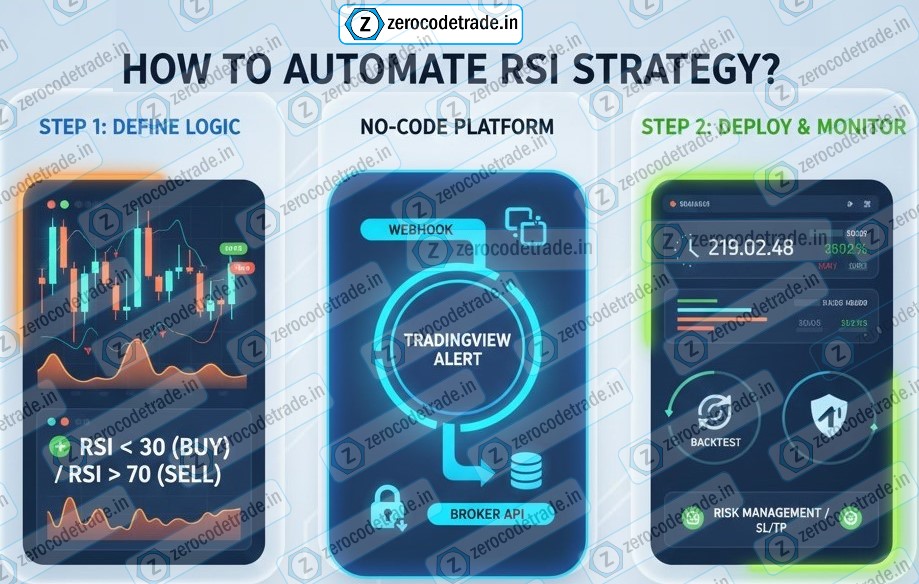
To automate a manual RSI strategy in 2026, define your rules using “If-Then” triggers (e.g., Buy if RSI < 30, Sell if RSI > 70). Next, connect a charting hub like TradingView via webhooks to an execution platform or broker. Always backtest your settings thoroughly and deploy via paper trading before risking live capital.
Author’s Advice & Important Risk Note
- High Risk Warning: Stock and options trading are high-risk endeavors that can result in significant financial loss. Before committing real capital to the live market, it is essential to start with backtesting, forward testing, and paper trading to validate your strategy.
- Do Your Own Due Diligence: Do not blindly trust any single broker, platform, influencer, or social media channel. The trading landscape is full of noise; your priority should be mastering the basics of market mechanics at your own pace.
- Educational Purpose Only: The insights shared on this website—including our analysis—are for informational and educational purposes only.
- Not SEBI Registered: We are not SEBI-registered advisors, and this content is not a recommendation to trade. Always perform your own independent research and testing before entering live markets.
Why Automate RSI in 2026?
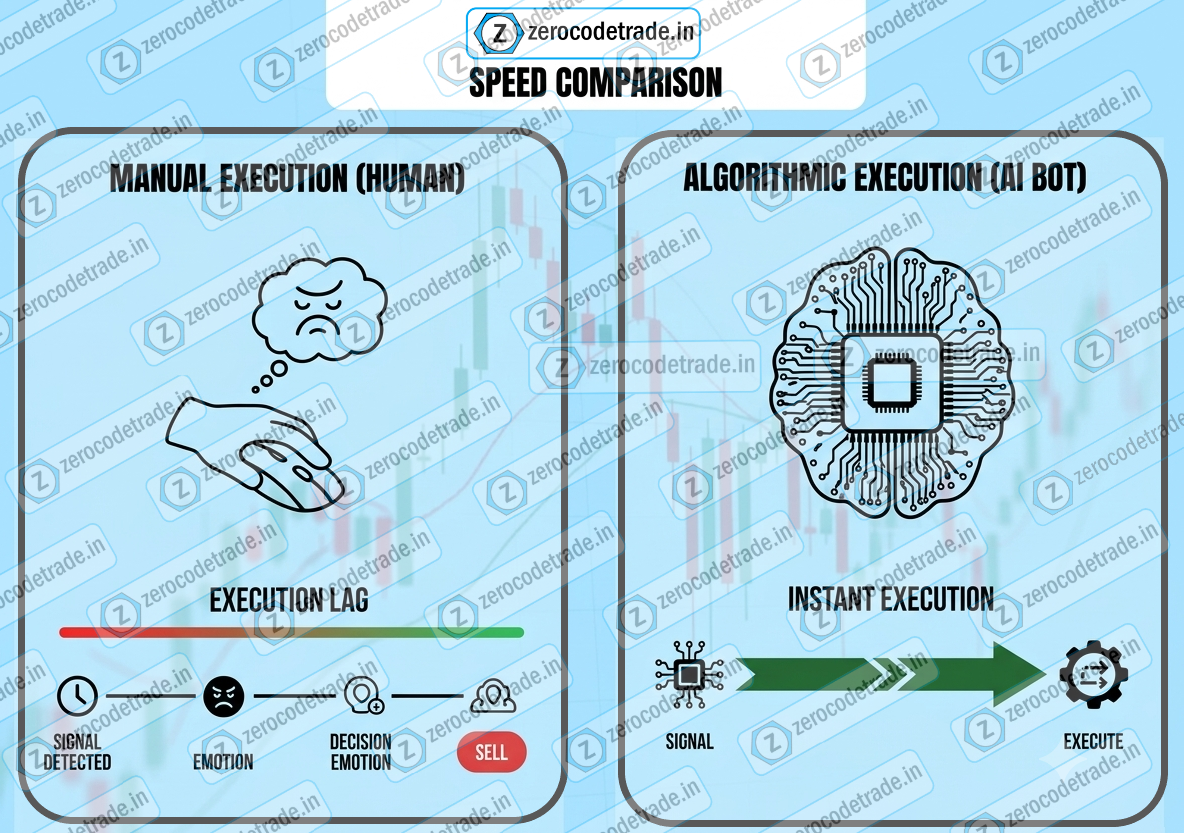
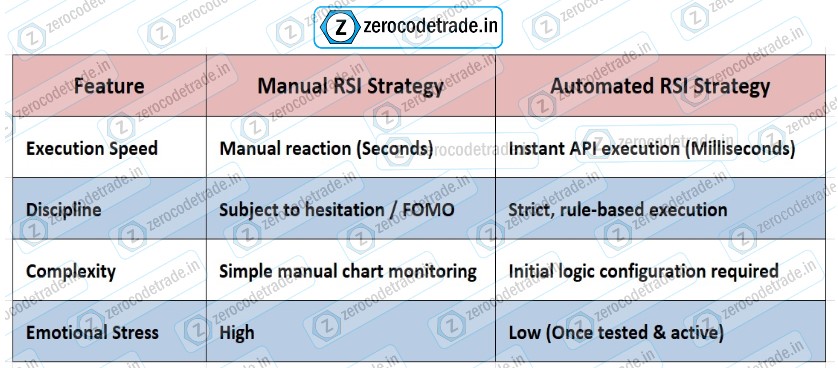
The 2026 market landscape is dominated by high-frequency institutional algorithms. If you have evaluated the critical differences between manual and algo trading, you already know that manual traders suffer from execution lag—the delay between your brain seeing a crossover and your finger clicking “Buy.”
- Eliminate Emotional Bias: A bot doesn’t hesitate when the RSI hits 28 during a market crash; it simply executes according to rules.
- 24/7 Market Coverage: While you sleep, an automated script can monitor international indices or cryptocurrency markets seamlessly.
- Backtesting Accuracy: You can test your exact RSI entry and exit triggers against 10 years of historical price action in seconds.
Step 1: Defining Your Manual RSI Logic
Before learning how to automate a manual RSI strategy, you must be surgical about your parameters. A computer cannot process vague statements like “I think it’s oversold.” You must provide concrete math and conditions.
The Classic RSI Setup
- Indicator: Relative Strength Index (14 Period).
- Entry Condition (Buy): RSI crosses ABOVE 30 from below.
- Exit Condition (Sell): RSI crosses BELOW 70 from above.
The 2026 “Pro” Modification
In modern volatile markets, the traditional 30/70 rule frequently results in fake-outs. Many systematic traders add a 50-line crossover filter or wait for divergence confirmation. If you are comparing rule-based algo bots vs. advanced AI trading systems, starting with a structured crossover setup remains the best approach for beginners.
Step 2: Choosing Your “No-Code” Automation Hub
In 2026, learning Python or C++ is no longer a prerequisite for automated trading. Several drag-and-drop platforms allow you to deploy strategies visually.
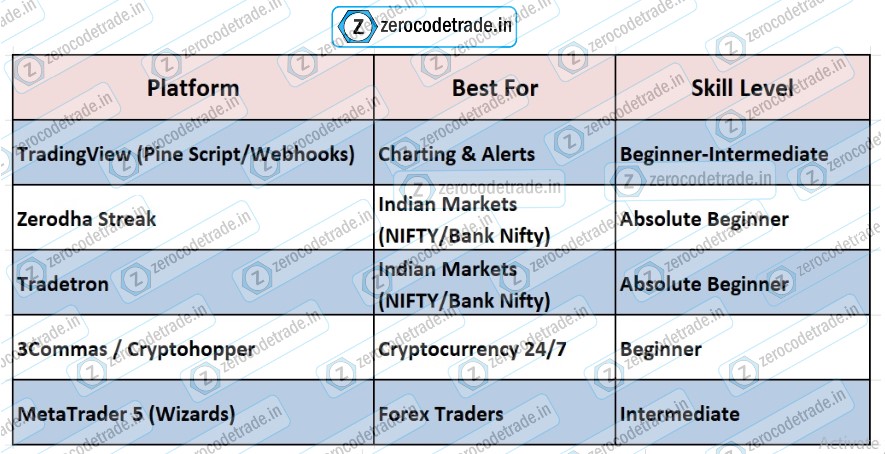
Recommendation: For most beginners, combining TradingView alerts with execution bridges like Tradetron or Streak offers the cleanest visual workflow.
Step 3: Building the Logic (The “If-This-Then-That” Flow)
Automation is simply a sequence of strict logical conditions. Here is how your RSI bot processes market data:
- Check Interval: Evaluates data on every candle close (e.g., 15-minute chart).
- Condition A: Is the RSI value < 30?
- Action A: Send an instant buy order request to the broker API.
- Condition B: Is the RSI value > 70?
- Action B: Send a close position/sell request.
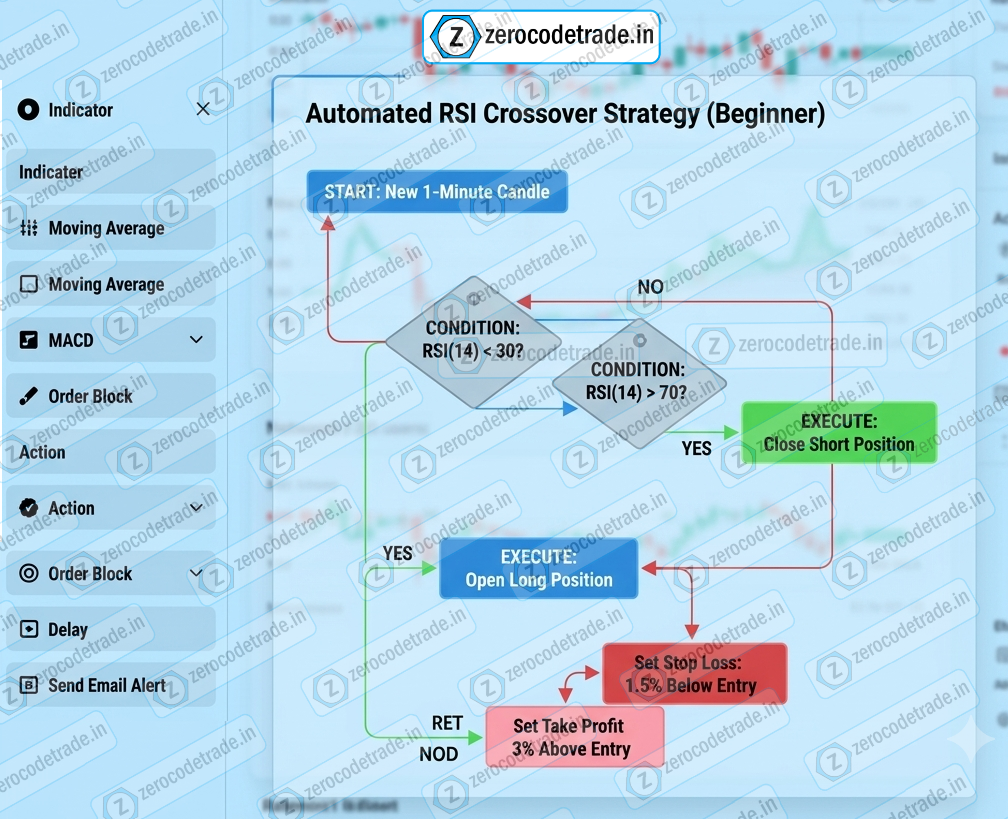
Pro Tip: Always embed a hard Stop Loss (SL) and Take Profit (TP) directly into your order instructions. An automated RSI strategy without risk controls can cause severe drawdowns if price remains trapped in an oversold or overbought regime during a strong trend.
Step 4: Backtesting – The Truth Serum
Before committing real funds, run your exact logic through historical data engines like AlgoTest or TradingView’s Strategy Tester.
- Analyze Maximum Drawdown: Determine the worst losing streak your strategy experienced over the past year. Ensure your risk parameters can withstand those equity dips.
- Win Rate vs. Risk-Reward: A 70% win rate is unhelpful if average losses significantly outweigh gains.
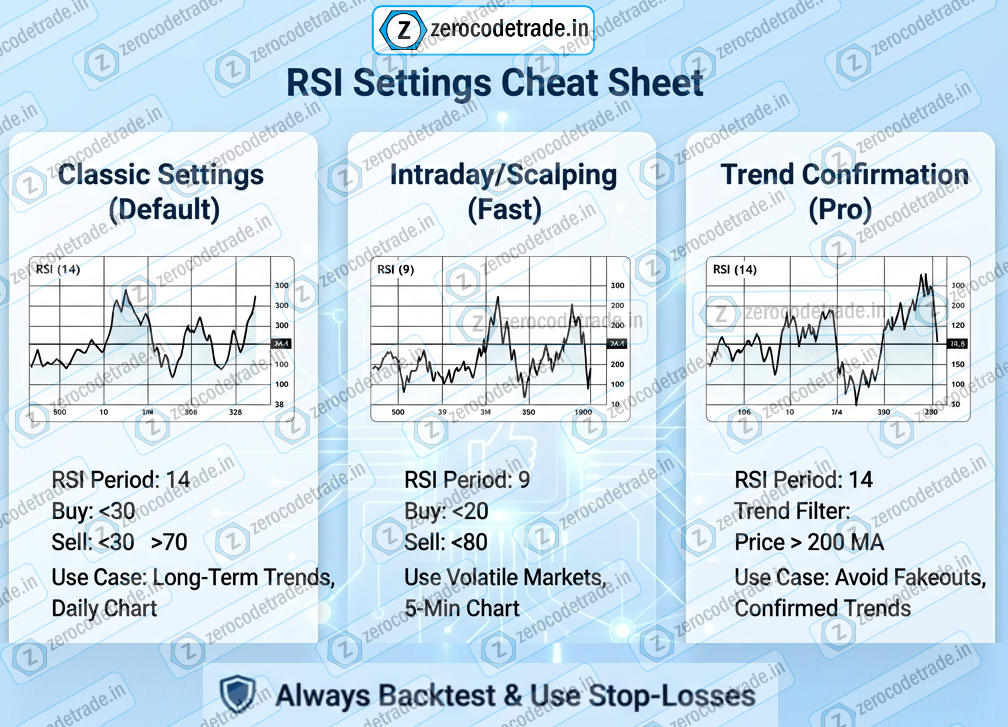
- Period Optimization: While 14 is the default RSI period, shorter periods (e.g., 9) may perform better on intraday charts, whereas longer periods (e.g., 21) suit swing strategies.
Step 5: Paper Trading (Virtual Deployment)
Never deploy a new automation rule live immediately. Every major platform provides virtual or paper trading environments. Run your automated setup with simulated funds for at least one week to verify webhook connection stability, order execution speed, and latency.
Step 6: Going Live with a “Micro-Account”
When transitioning to real capital, follow a disciplined scaling framework:
- Start Small: Commit no more than 10% of your intended strategy capital initially.
- Monitor API Connections: Ensure your broker bridge and charting engine maintain stable connections without execution delays.
- Set a Daily Kill Switch: Configure maximum daily drawdown limits so your platform halts trading automatically if market conditions deteriorate.
Common Pitfalls for RSI Beginners
1. The “RSI Stay” Problem
During powerful trend cycles, RSI can remain above 70 or below 30 for extended periods. If a bot blindly shorts every overbought reading, strong momentum will steamroll your position.
- Solution: Integrate a trend filter such as the 200-period Moving Average (200 MA). Only execute long signals when price trades above the 200 MA.
2. Over-Optimization (Curve Fitting)
Tweaking parameters until historical performance looks flawless often causes failure in forward testing. Keep logic clean and simple for better out-of-sample robustness.
The Cost of Automation in 2026
Before getting started, budget for typical operational costs:
- Platform Subscriptions: No-code tools and alert hubs generally range between $15–$50/month. For a detailed cost breakdown, explore our guide on the cost of Algo trading (rule-based bots) vs. AI trading setups.
- Data Feeds: Real-time exchange feeds are required for low-latency triggers.
- Slippage & Spreads: Account for small execution discrepancies between order trigger and broker fulfillment.
Summary: Manual vs. Automated RSI
Conclusion: Taking the First Step
Knowing how to automate a manual RSI strategy isn’t about replacing trading judgment—it’s about automating execution discipline. By removing manual order placement, you can focus on strategy design, backtesting, and systematic risk management.
If you are expanding your research into modern algorithmic tools, check out our tutorial on how to trade stocks using Grok AI for market analysis. Start by configuring a simple RSI alert on TradingView today; that single alert is your first step toward fully systematic trading.
FAQ (Frequently Asked Questions)
Is algo trading for beginners safe?
Yes, provided you perform rigorous paper testing and use strict stop-loss rules before committing real funds.
Advanced FAQs for RSI Automation in 2026
What are the “Golden” RSI settings for 5-minute intraday automation?
While 14 is default, many day traders utilize a 9-period RSI with tighter 80/20 bands on 5-minute charts to capture short-term momentum while filtering out choppy price noise.
Can I run my RSI bot on a mobile phone?
You can monitor performance via mobile apps, but the execution logic should run on cloud platforms or a VPS (Virtual Private Server) to guarantee 24/7 uptime without loss of mobile connectivity.
What is the “RSI Divergence” trap in automation?
RSI divergence occurs when price sets a new high/low while RSI fails to confirm. Coding divergence logic cleanly can be tricky and may lead to indicator “repainting.” Beginners should master standard crossover logic (30/70) before attempting complex divergence triggers.
Disclaimer
We are here to help you navigate the complex world of 2026 trading technology. While we provide insights on Algo trading, AI trading, AI tools, indicators, platforms, and suggestions, please understand that this is not financial advice, nor is it a recommendation to trade.
Trading involves significant financial risk. Automated tools are meant to assist your workflow, but they do not guarantee profits or provide a “magic button” for income. Always Backtest, Paper Trade, and Start Small to protect your capital.
Limitation of Liability: Zerocodetrade.in and its authors are not responsible for any financial losses, damages, or missed profits that may result from the use of the content, strategies, or third-party tools mentioned in this blog. All trading decisions are made at your own risk.

“Written by Laxmi Narayan — A stock trader since 2021, he has focused on merging traditional technical analysis with modern tools like Grok AI, ChatGPT to simplify and to educate about various trading patterns and styles, Laxmi shares his knowledge and insights for educational and informational purposes only.”