
Best AI Tools for Automated Stock Trading Without Coding
Finding the best AI tools for automated stock trading has moved from being a luxury to becoming an essential advantage in modern trading. Whether you are a BTST trader, swing trader, or long-term investor, leveraging the best AI tools for automated stock trading can help you analyze massive datasets, find hidden chart patterns, evaluate market sentiment, and execute parts of your strategy without writing code.
Below is a curated review of top platforms to help you choose the best AI tools for automated stock trading tailored to your workflow, including their features, pricing, strengths, and limitations.
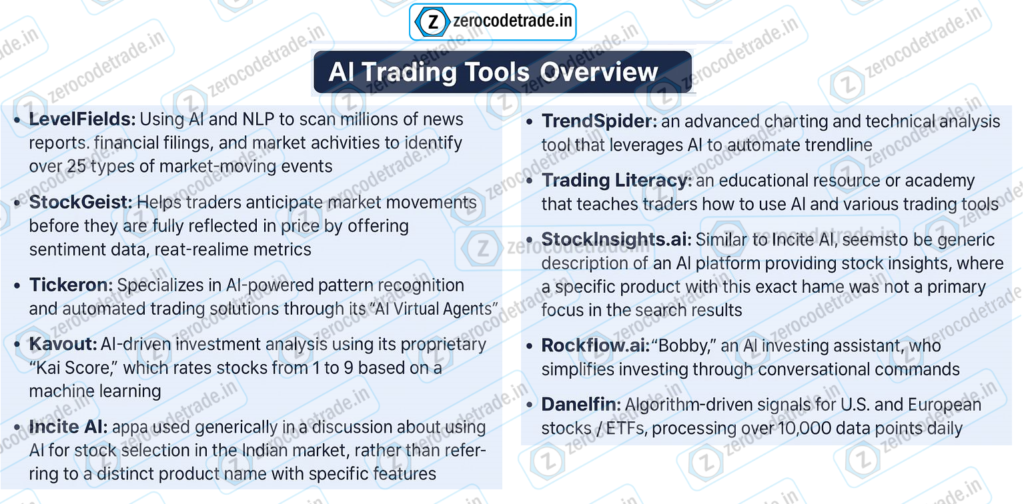
At a Glance: Best AI Tools for Automated Stock Trading Without Coding
The best AI tools for automated stock trading without coding allow retail traders to backtest strategies, detect chart patterns, scan sentiment, and automate trades using simple visual interfaces.
- Best for Automated Charting & Technicals: TrendSpider
- Best for Event-Driven & BTST Signals: LevelFields
- Best for Pattern Recognition & AI Signals: Tickeron
- Best for No-Code Sentiment Analysis: StockGeist
- Best Free / Beginner AI Score Tool: Danelfin & Incite AI
Unlike rigid algorithmic trading scripts, modern AI tools process unstructured news, SEC filings, and technical indicators in real time to assist trade execution without requiring Python or Pine Script knowledge.
Author’s Advice & Important Risk Note
- High Risk Warning: Stock and options trading are high-risk endeavors that can result in significant financial loss. Before committing real capital to the live market, it is essential to start with backtesting, forward testing, and paper trading to validate your strategy.
- Do Your Own Due Diligence: Do not blindly trust any single broker, platform, influencer, or social media channel. The trading landscape is full of noise; your priority should be mastering the basics of market mechanics at your own pace.
- Educational Purpose Only: The insights shared on this website—including our analysis—are for informational and educational purposes only.
- Not SEBI Registered: We are not SEBI-registered advisors, and this content is not a recommendation to trade. Always perform your own independent research and testing before entering live markets.
The Future of AI and Should You Consider Using It?
Artificial Intelligence is fundamentally shifting the stock market landscape. What used to be exclusive to institutional hedge funds—such as processing millions of news articles, earnings reports, and tick data in real time—is now accessible to retail traders through no-code platforms.
Where AI Trading is Heading
- Natural Language Processing (NLP): Modern AI can digest SEC filings, earnings call transcripts, and market sentiment in seconds, extracting core insights faster than humanly possible.
- Predictive Pattern Recognition: Instead of manually drawing trendlines, machine learning models analyze historical price action across thousands of charts to identify high-probability setups.
- Adaptive Risk Management: Emerging AI models can dynamically suggest position sizing or stop-loss adjustments based on live market volatility.
Should You Use AI in Your Trading?
Yes, but as an assistant, not an oracle. AI excels at reducing manual research time, removing emotional bias, and discovering non-obvious patterns. However, it cannot replace core market understanding, risk management, and capital preservation. If you want to scale your research efficiency and refine your entry/exit signals without learning complex programming languages like Python, incorporating the best AI tools for automated stock trading into your workflow is a net positive step.
Is AI Better Than Other Automated Tools Like Algo Trading?
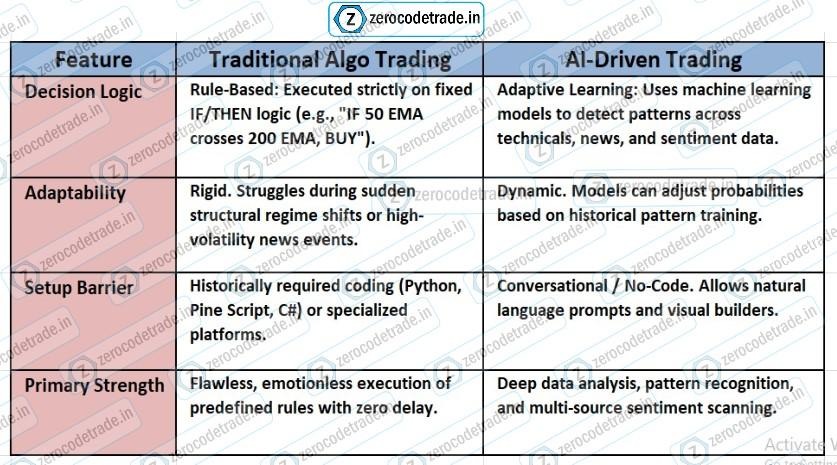
A common point of confusion for retail traders is the difference between traditional Algorithmic (Algo) Trading and AI-Driven Trading. Both automate aspects of trading, but they operate on completely different logic. If you are weighing the costs and mechanics between these two approaches, read our detailed comparison on Algo vs. AI Trading: Which No-Code Automation Tool is Best for Retail Traders?.
Which One is Better?
Neither is inherently “better”—they complement each other. Traditional algo trading is superior for strict, execution-heavy rule enforcement (such as automated order placement on breakouts). For example, if you rely on momentum indicators, check our guide on whether Is RSI Algo Trading Better Than AI Bots?. Meanwhile, AI is superior for context gathering, sentiment analysis, and pattern discovery. The most powerful modern workflows combine both: using AI to find and validate trading setups, and using traditional algos to execute orders automatically without emotion.
Advantages and Disadvantages of Using the Best AI Tools for Automated Stock Trading
Before adopting AI platforms into your daily workflow, it is crucial to weigh their practical benefits against their current limitations.
Advantages
- Speed & Processing Power: Scans thousands of stocks, charts, and news headlines in milliseconds—tasks that would take a human trader hours.
- Removal of Emotional Bias: Provides objective data, statistical confidence scores, and historical probabilities without fear, greed, or revenge trading.
- Accessibility for Non-Coders: Enables retail traders to build, test, and refine quantitative strategies using simple visual interfaces or conversational prompts.
- Multi-Timeframe & Sentiment Analysis: Simultaneously analyzes macro news, social sentiment, and multi-timeframe price charts to provide a holistic market view.
Disadvantages
- Subscription Costs: High-tier AI platforms with low latency and premium real-time data feeds can carry steep monthly or annual price tags. For a breakdown of expenses, read our analysis on the Cost of Algo vs. AI Trading: Why Should You Start with Rule-Based Bots.
- Risk of Over-Reliance: Relying blindly on an AI “confidence score” without understanding underlying price action can lead to unexpected drawdowns.
- Hallucinations & False Signals: Generative AI models can occasionally misinterpret financial jargon or produce false sentiment signals during unexpected market noise.
- Steep Learning Curve: Even “no-code” AI tools require learning curve time to set proper parameters, filter noise, and interpret data correctly.
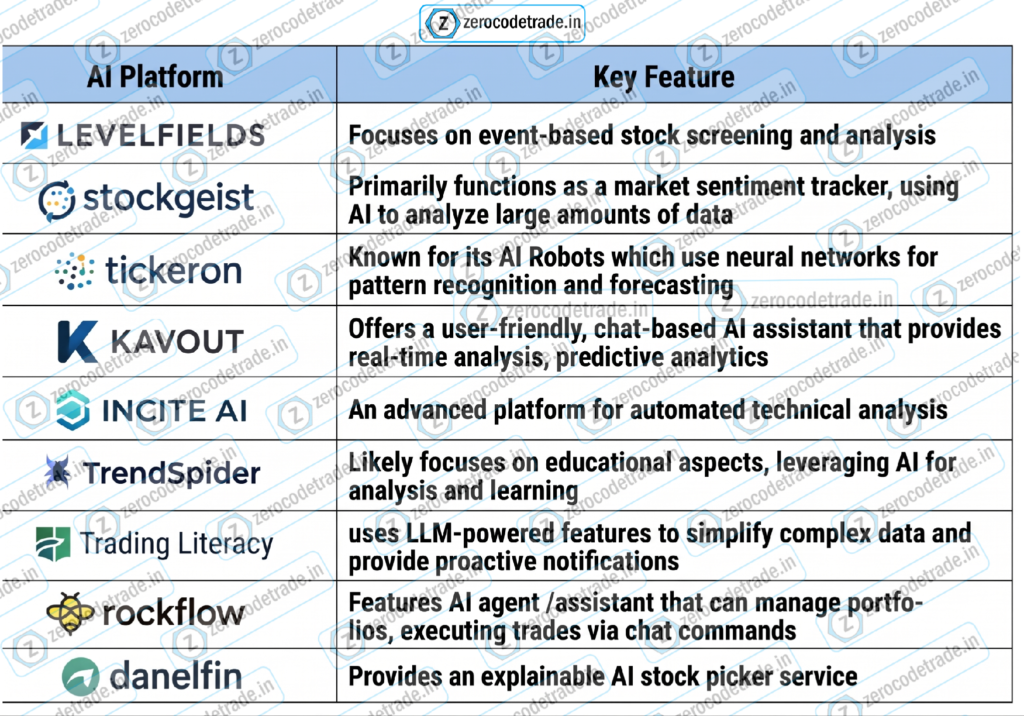
Better Alternate Tools Compared to AI Tools (Cost-Effective Options)
Because dedicated AI trading tools often lock their best features behind expensive monthly subscriptions, beginner traders or those on a tight budget should consider cost-effective or free alternatives that deliver high analytical value without heavy recurring fees.
1. Traditional Technical Charting Platforms (Free / Low Cost)
- TradingView (Free / Basic Plans): Excellent built-in technical indicators, multi-timeframe analysis, and community scripts. While it offers premium AI add-ons, its core free indicators provide 80% of what a technical trader needs.
- Chartink (Free for Indian Stock Market): A powerful, free condition-based screener for intraday, swing, and breakout setups. It operates on pure technical filters without charging recurring AI subscription fees.
2. Native No-Code Algo Platforms
- Zerodha Streak & AlgoTest: Excellent alternatives for Indian retail traders looking to backtest and automate rule-based strategies without writing code. Explore our roundup of the Best No-Code Algo Trading Platforms for Beginners or learn step-by-step How to Create Algo Trading Strategy in Zerodha Streak.
3. Fundamental & Financial News Aggregators
- Screener.in & Yahoo Finance: Free tools for running deep fundamental filters, reviewing balance sheets, and tracking historical earnings without paying for high-tier AI document processors.
4. General LLMs with Financial Customization
- ChatGPT (Free / Plus) & Grok: Instead of paying high monthly fees for specialized financial AI software, you can use general AI tools to analyze pasted earnings transcripts, summarize financial disclosures, or draft indicator logic for free or at a low monthly cost.
Top 10 Options: Best AI Tools for Automated Stock Trading Reviewed
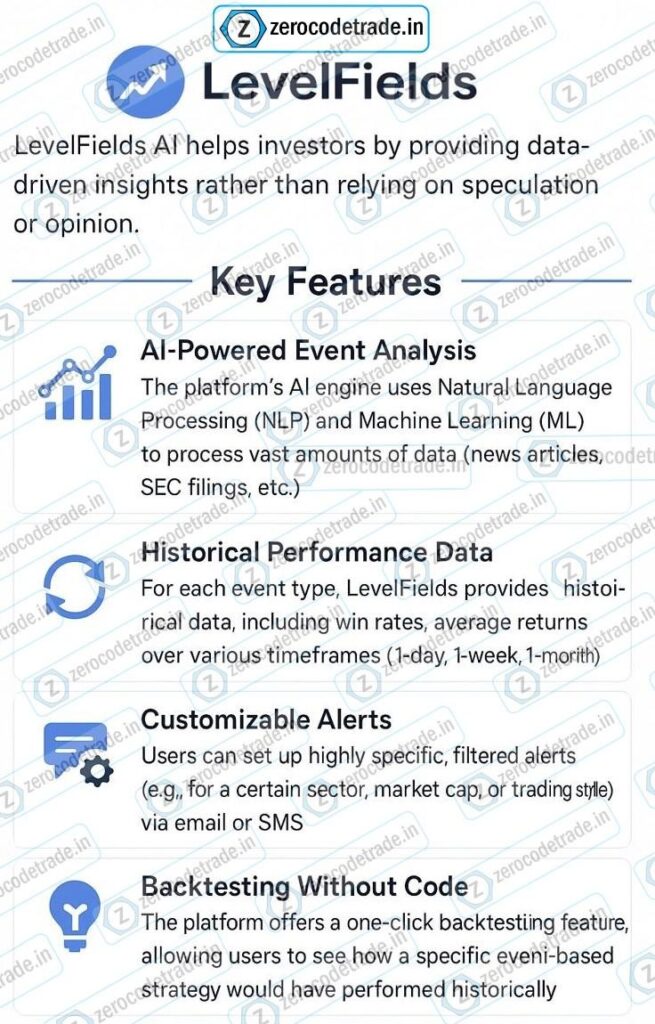
1. LevelFields
LevelFields automates event-driven research by scanning thousands of stocks to detect events such as earnings surprises, buybacks, insider trades, and more. It highlights events known to historically impact stock prices and provides directional context.
Pricing
- $25/month (annual billing)
- $1599/year — premium alerts + training
Pros
- Excellent for event-based BTST trades
- Saves hours of manual news and report scanning
- Rich historical context for each event
- Ideal for short-term actionable signals
Cons
- Can overwhelm beginners
- Premium tier is expensive
- Less useful for pure technical traders
2. StockGeist
StockGeist tracks real-time market sentiment for 2,200+ companies by analyzing live social media chatter. Its sentiment dashboard is useful for traders who rely on crowd psychology and momentum.
Pricing
- Free tier
- Paid tiers: $50 and $100 per month
Pros
- Great for momentum and sentiment-driven traders
- Real-time data
- Free version available
- Works well with technical indicators
Cons
- Noise can produce false sentiment signals
- Must be combined with other analysis
- Paid tiers required for deep sentiment history
3. Tickeron
Tickeron offers multiple AI agents for various tasks — pattern search, breakout detection, forecasting, real-time signals, stock screening, and more.
Pricing
- Free 13-day trial
- $30/month afterward
Pros
- Wide variety of AI tools in one place
- Confidence percentages for patterns
- Excellent for strategy builders
- Ideal for swing traders
Cons
- Feature-heavy for new traders
- Higher value locked behind paid plans
- Not ideal for long-term investing
4. Kavout
Kavout blends structured and unstructured financial data to offer deeply analytical insights. InvestGPT, its chat-based interface, allows traders to ask questions and get immediate research summaries.
Pricing
- Free tier
- Pro: $20/month
Pros
- Strong AI-powered insights
- Blends multiple data pipelines
- Excellent for fundamentals + technicals combo
- Affordable Pro tier
Cons
- Strongest in US market coverage
- Free plan has limitations
- Requires user judgment for execution
5. Incite AI
Incite AI uses real-time data for forecasting, simulations, scenario modeling, and pattern analysis. It describes itself as “Live Intelligence” due to its instantaneous processing capability.
Pricing
- Currently free
Pros
- Exceptional for real-time decision-making
- Powerful simulations and forecasting
- Free to use
- Ideal for strategy testers
Cons
- Pricing may change
- Could be too advanced for beginners
- Still expanding asset coverage
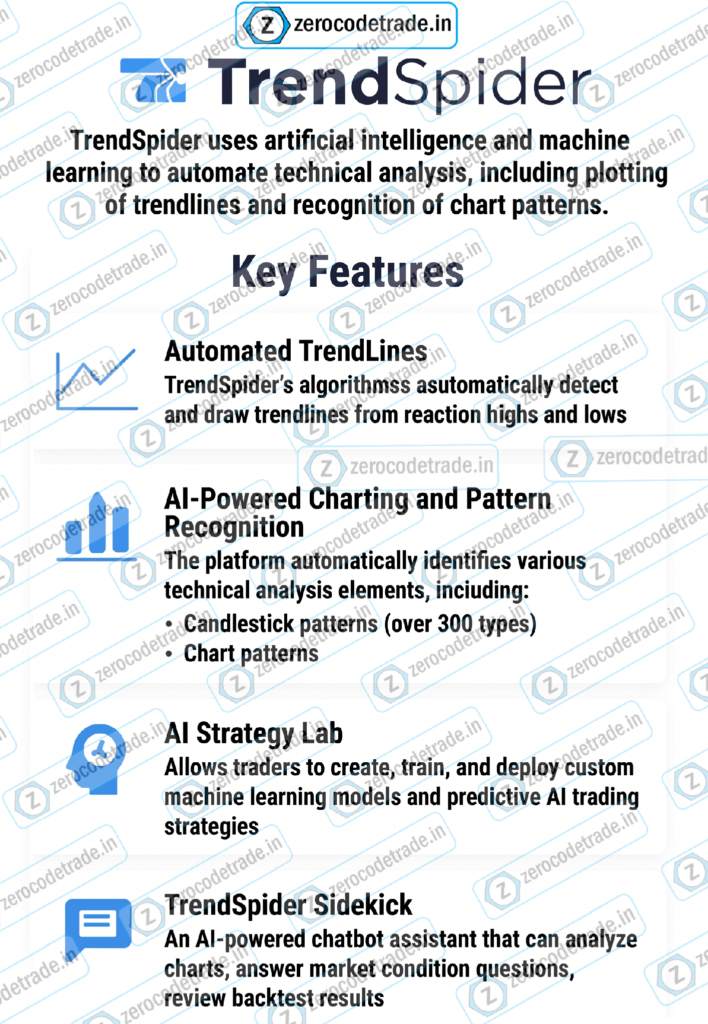
6. TrendSpider
TrendSpider is an AI-powered technical analysis platform known for automated trendlines, multi-timeframe alerts, pattern detection, and backtesting.
Pricing
- $19/month — Standard
- $29/month — Premium
- $39/month — Elite
Pros
- Best in class for automated charting
- Multi-timeframe alerts
- Custom strategies + machine-learning tools
- Ideal for swing and technical traders
Cons
- Steeper learning curve
- Slightly pricey for beginners
- Technical-only focus (no fundamentals)
7. Trading Literacy
Trading Literacy is a GPT-style conversational AI tool that generates reports, risk insights, summaries, and portfolio-based intelligence through simple prompts.
Pricing
- Investor: $19/month
- VIP: $119/month
Pros
- Chat-based, easy to use
- Supports document uploads
- Ideal for portfolio investors
Cons
- VIP tier is expensive
- Limited real-time market analytics
- Works best when paired with other tools
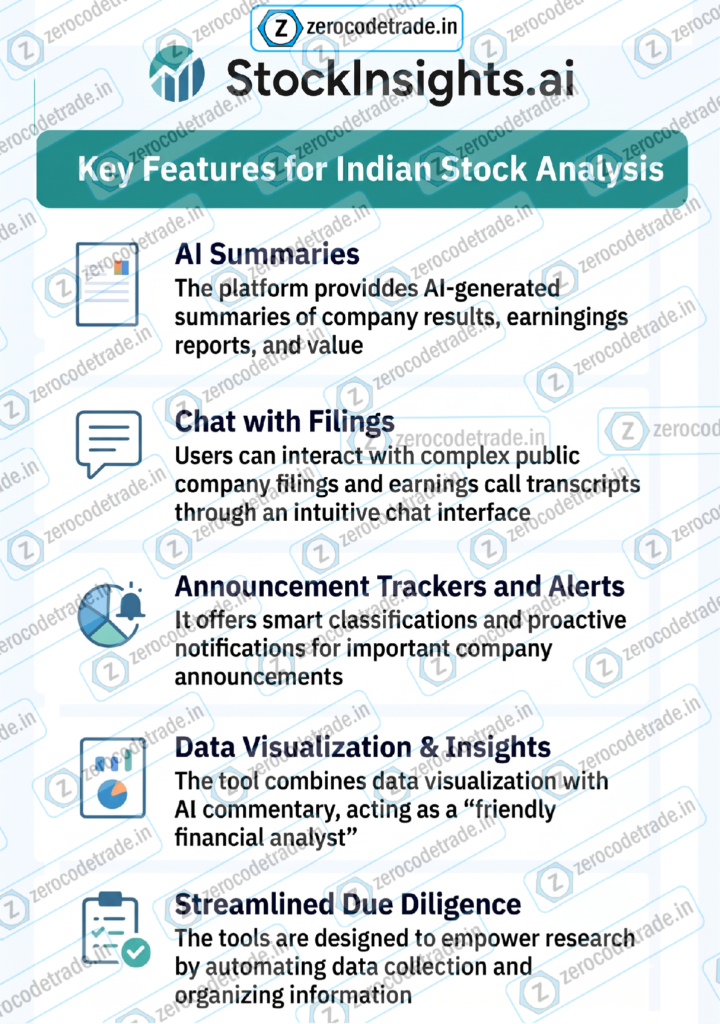
8. StockInsights.ai
StockInsights.ai focuses on analysing Indian and US stocks using generative AI. It reads filings, earnings transcripts, call notes, presentations, and disclosures.
Pricing
- Free tier
- Paid: $200/year
- Custom plans for large users
Pros
- Strong at extracting meaning from text-heavy documents
- Excellent for fundamental traders
- API available for workflow integration
- Indian market support
Cons
- Limited for pure technical traders
- Paid plan required for full features
- Still building its brand reputation
9. Rockflow.ai
Rockflow is a Gen-Z friendly AI-driven investing platform. It uses TradeGPT and quant models to give daily trading ideas and supports micro-investing with as little as $1.
Pricing
- No subscription fee
- Charges per trade/deposit/withdrawal
Pros
- Very beginner-friendly
- Daily AI signals
- Micro-investing for new traders
- No subscription cost
Cons
- Fees can add up for active traders
- Less suitable for experienced traders
- No fixed cost structure
10. Danelfin
Danelfin assigns a simple Global AI Score (1 to 10) to stocks/ETFs to show their probability of outperforming the market over the next 3 months.
Pricing
- Free tier
- $19/month
- $52/month
Pros
- Simple score-based system
- Great for beginners
- Covers US + Europe stocks
Cons
- Not ideal for short-term traders
- Coverage limited to select regions
- Advanced insights behind paid plans
Frequently Asked Questions
1. Are AI tools reliable for stock trading?
They’re reliable for analysis, not predictions. They assist — not guarantee profits.
2. Which AI tool is best for swing and BTST trading?
TrendSpider, LevelFields, and Tickeron are top choices among the best AI tools for automated stock trading.
3. Can beginners use AI trading platforms?
Yes — especially Danelfin, Rockflow, and Trading Literacy.
4. Are free AI tools useful?
Absolutely. StockGeist, Incite AI, and Kavout provide powerful free features.
5. Can AI replace my trading strategy?
No. AI improves your speed and accuracy, but you still need your own strategy.
Conclusion
The best AI tools for automated stock trading are transforming how traders approach the market. Whether you trade BTST, intraday, swing, or long-term, these tools help speed up research, uncover hidden patterns, and improve execution.
But remember: AI tools amplify your strategy — they do not replace it. Pair them with risk management and a consistent approach, and they can significantly improve your trading edge.
Disclaimer
We are here to help you navigate the complex world of modern trading technology. While we provide insights on Algo trading, AI trading, AI tools, indicators, platforms, and suggestions, please understand that this is not financial advice, nor is it a recommendation to trade.
Trading involves significant financial risk. Automated tools are meant to assist your workflow, but they do not guarantee profits or provide a “magic button” for income. Always Backtest, Paper Trade, and Start Small to protect your capital.
Limitation of Liability: Zerocodetrade.in and its authors are not responsible for any financial losses, damages, or missed profits that may result from the use of the content, strategies, or third-party tools mentioned in this blog. All trading decisions are made at your own risk.

“Written by Laxmi Narayan — A stock trader since 2021, he has focused on merging traditional technical analysis with modern tools like Grok AI, ChatGPT to simplify and to educate about various trading patterns and styles, Laxmi shares his knowledge and insights for educational and informational purposes only.”