
Best Zerodha Streak BTST & Swing Trading Strategies for Algo Trading
Mastering Zerodha Streak BTST & Swing Trading Strategies can completely transform how retail traders execute short-term momentum and overnight setups without needing complex programming knowledge. Algo trading platforms have made strategy testing far more accessible for retail traders in India. One such platform is Zerodha Streak, which allows traders to create, backtest, and monitor rule-based trading strategies without writing code.
In this article, we’ll cover:
- What pre-existing strategies are available in Streak
- Which setups are best suited for BTST and swing trading
- How to manually create and backtest your own strategies
- Practical backtest observations and improvement tips
Overview of Zerodha Streak BTST & Swing Trading Strategies
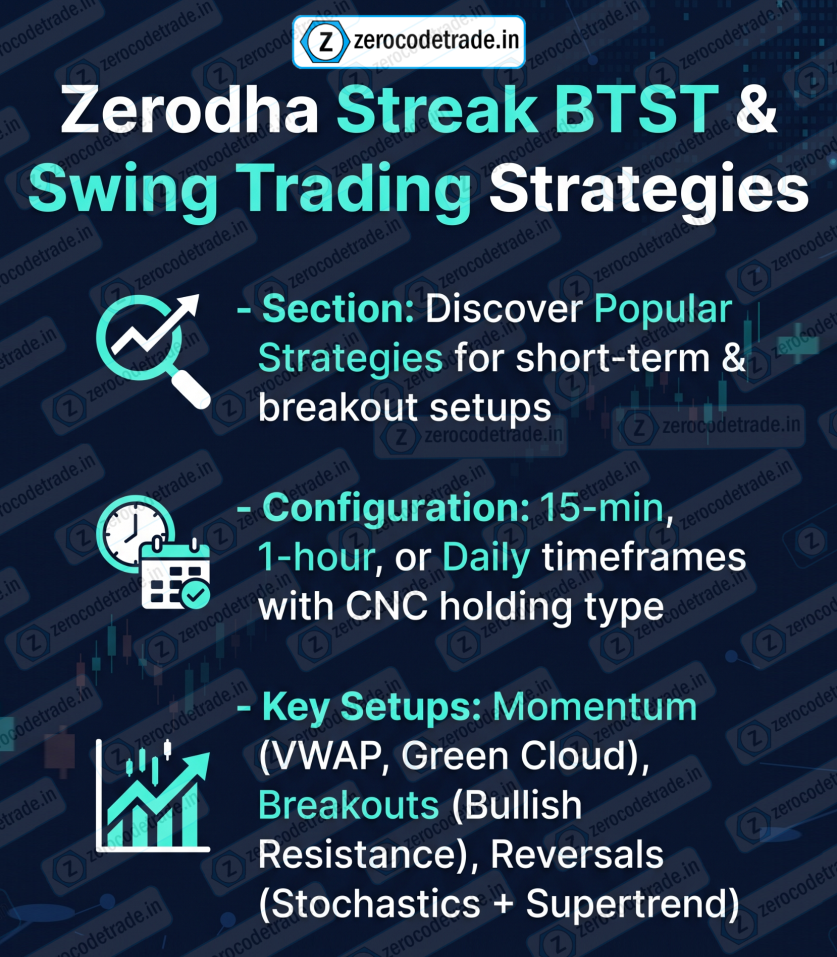
Zerodha Streak BTST & Swing Trading Strategies leverage pre-built technical templates under the “Discover Popular Strategies” section to automate short-term momentum and breakout setups. Since Streak does not explicitly tag strategies as BTST or swing, traders select hourly or daily timeframes paired with CNC holding types. Key pre-existing setups include Momentum (VWAP, Green Cloud), Breakouts (Bullish Resistance, Price Action), and Reversals (Stochastics + Supertrend).
📺 Watch our Video explaining BTST & Swing Trading Strategies in Zerodha Streak
Author’s Advice & Important Risk Note
- High Risk Warning: Stock and options trading are high-risk endeavors that can result in significant financial loss. Before committing real capital to the live market, it is essential to start with backtesting, forward testing, and paper trading to validate your strategy.
- Do Your Own Due Diligence: Do not blindly trust any single broker, platform, influencer, or social media channel. The trading landscape is full of noise; your priority should be mastering the basics of market mechanics at your own pace.
- Educational Purpose Only: The insights shared on this website—including our analysis—are for informational and educational purposes only.
- Not SEBI Registered: We are not SEBI-registered advisors, and this content is not a recommendation to trade. Always perform your own independent research and testing before entering live markets.
Pre-Existing Strategies in Zerodha Streak – What’s Available?
To explore ready-made Zerodha Streak BTST & Swing Trading Strategies, navigate to the “Discover Popular Strategies” section inside the platform. Here, you’ll find 150+ pre-built strategies based on widely used technical indicators.
These strategies can be filtered by:
- Timeframe (15-minute, hourly, daily, etc.)
- Market view (bullish or bearish)
- Chart type and indicator combinations
👉 Important note: Zerodha Streak does not explicitly label strategies as “BTST” or “Swing Trading.” Instead, suitability depends on the timeframe and holding logic you choose.
Timeframes That Matter
- BTST & Swing Trading: Hourly and Daily charts
- Intraday Trading: 5-minute or 15-minute charts
By selecting longer timeframes and CNC holding types, you can adapt many pre-existing setups into viable Zerodha Streak BTST & Swing Trading Strategies for overnight or multi-day trades. If you are evaluating different tools before committing, check out our guide on the Best No-Code Algo Trading platforms for Beginners, or explore popular external tools like Tradetron, AlgoTest, and uTrade Algos.
Types of Pre-Existing Strategies Suitable for BTST & Swing Trading
Most strategies in Streak are rooted in classical technical analysis. When applied to hourly or daily timeframes, the following categories work particularly well for BTST and swing setups.
Momentum & Trend-Following Strategies
These strategies aim to capture short- to medium-term price momentum and are commonly used for overnight and multi-day holds.
Examples Available in Zerodha Streak:
- VWAP Confirmation (Hourly): This strategy initiates a buy position when the stock price moves above the Volume-Weighted Average Price (VWAP) indicator, suggesting bullish momentum.
- Green Cloud Momentum (Hourly/Daily): Utilizes the Ichimoku Cloud to identify strong trends and momentum. A buy signal is triggered when the trend and momentum align in a bullish direction.
- Weighted MA Bullish Trend (Hourly/Daily): Triggers a buy when the price breaks out of a Weighted Moving Average (WMA) resistance, and the WMA itself indicates a bullish trend.
These strategies are especially useful when markets are trending rather than range-bound.
Breakout Strategies
Breakout strategies attempt to catch the early phase of a new trend, making them ideal for Zerodha Streak BTST & Swing Trading Strategies.
Common Breakout-Style Strategies:
- Bullish Resistance with Momentum (Hourly): Identifies when a stock breaks a recent resistance level with significant momentum (e.g., high volume), indicating strong upward potential.
- Comparative RS Breakout (Hourly/Daily): Focuses on stocks breaking out of a downtrend, confirmed by relative strength (RS) indicators showing a shift in momentum compared to an index or sector.
- Price Action Breakout (Customizable): While not a single pre-built strategy name, buying above the previous session’s high is a simple yet effective concept that can be configured on Streak for BTST/swing trading.
Reversal Strategies
Reversal strategies suit traders expecting a change in direction after exhaustion or consolidation.
Examples:
- High Wave Candle Strategy (Hourly): Looks for specific candlestick patterns (high wave candles) that suggest market indecision, which can sometimes precede a trend reversal.
- Stochastics + Supertrend (Hourly/Daily): Uses oscillators like Stochastics along with Supertrend to confirm potential bullish reversals.
Key Considerations for BTST & Swing Trading in Zerodha Streak
Before deploying any strategy, keep these practical points in mind:
- Timeframe Selection: Select “15-min” or “1-hour” timeframes for BTST and Swing strategies, as long as your holding type is set to CNC (Cash & Carry) for delivery. Avoid micro-timeframes like “1-min” or “5-min”, which are intended solely for intraday scalping.
- Holding Type: When creating or deploying a strategy, select the correct “Holding type” (CNC for equity delivery) to allow for overnight positions, which is necessary for BTST and swing trading.
- Risk Management: Customize the Stop Loss (SL) and Target Profit (TP) percentages to align with your risk tolerance for overnight volatility.
- Backtesting: Always backtest the strategy with relevant historical data before deploying it in the live market to assess its performance and risk.
- Execution Reality: Remember that Streak provides one-click notifications/alerts for trade signals; you still need to manually place the buy/sell orders as full automation isn’t permitted for retail traders in India.
Creating Your Own BTST & Swing Trading Strategies in Zerodha Streak
Now that we’ve seen pre-existing strategies, let’s build custom Zerodha Streak BTST & Swing Trading Strategies and analyze their backtest performance.
What Makes Algo-Based BTST & Swing Strategies Work?
- Short-Term Momentum Logic: You want to catch short bursts of momentum that typically last 1–3 days.
- Clear Entry & Exit Rules: Algo systems perform best with defined triggers—no room for “gut feeling.”
- Defined Risk Control: Fixed stop-loss and profit target levels are musts to survive overnight gap risks.
- Simplicity: Overloading with 4–5 indicators leads to signal conflict—2 well-chosen indicators work much better.
For a deeper dive into rule-based setups vs complex AI models, read our analysis on Algo vs. AI Trading: Which No-Code Automation Tool is Best for Retail Traders?.
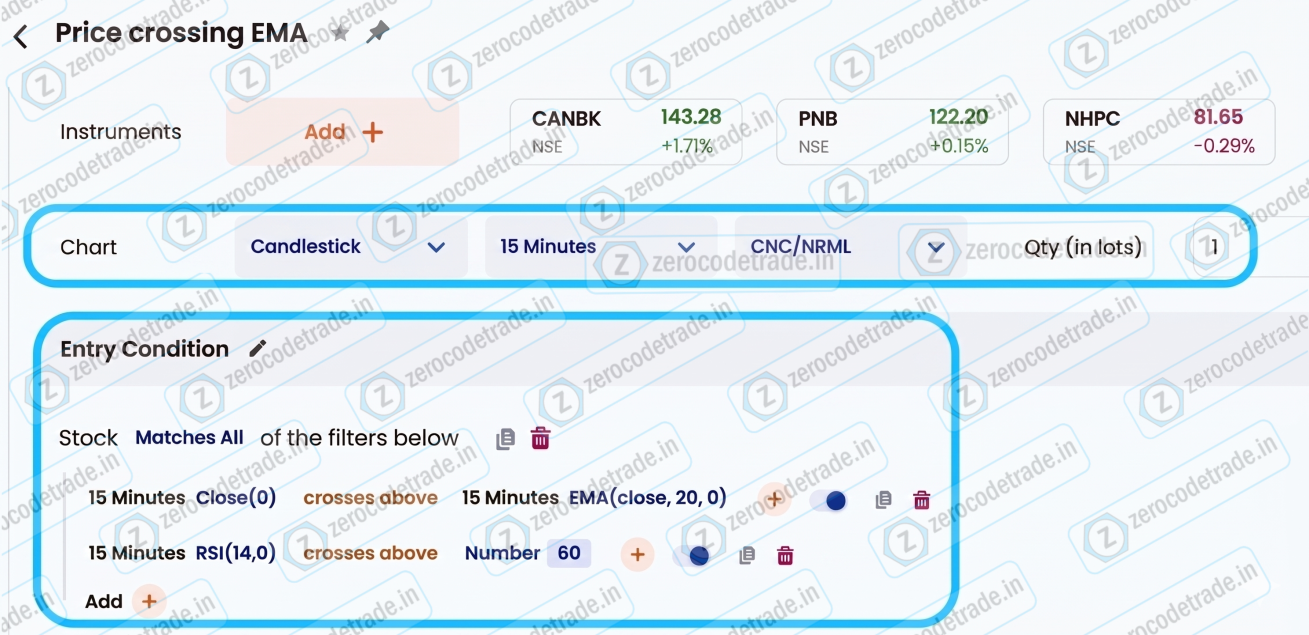
BTST Strategy for Zerodha Streak (Momentum Breakout)
- Goal: Catch stocks breaking out from short-term consolidation, holding overnight for small gains.
- Type: Short-term (1 day holding)
Strategy Rules:
- Buy Condition:
- Close price crosses above the 20-day Exponential Moving Average (EMA20)
- AND RSI (14) crosses above 60
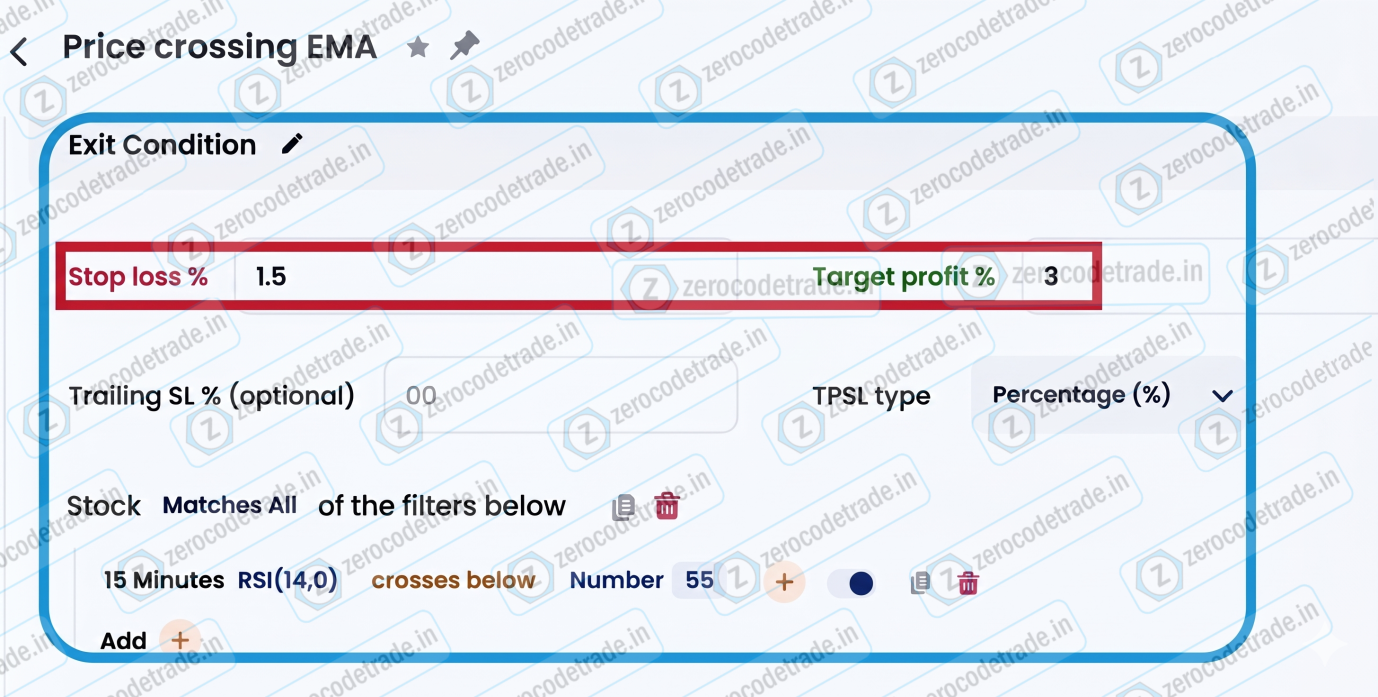
- Sell Condition:
- Next day, exit position at market open OR when RSI (14) crosses below 55
- Stop Loss: 1.5%
- Target Profit: 3%
- Time Frame: 15-minute or 1-hour
- Stocks Universe: NIFTY 100 or NSE Midcap 100
Why it works:
This strategy rides short bursts of buying pressure as a stock breaks above a recent average and momentum indicator confirms strength. It suits BTST because entries often trigger late in the day, and price follow-through occurs the next morning.
Backtest Observation
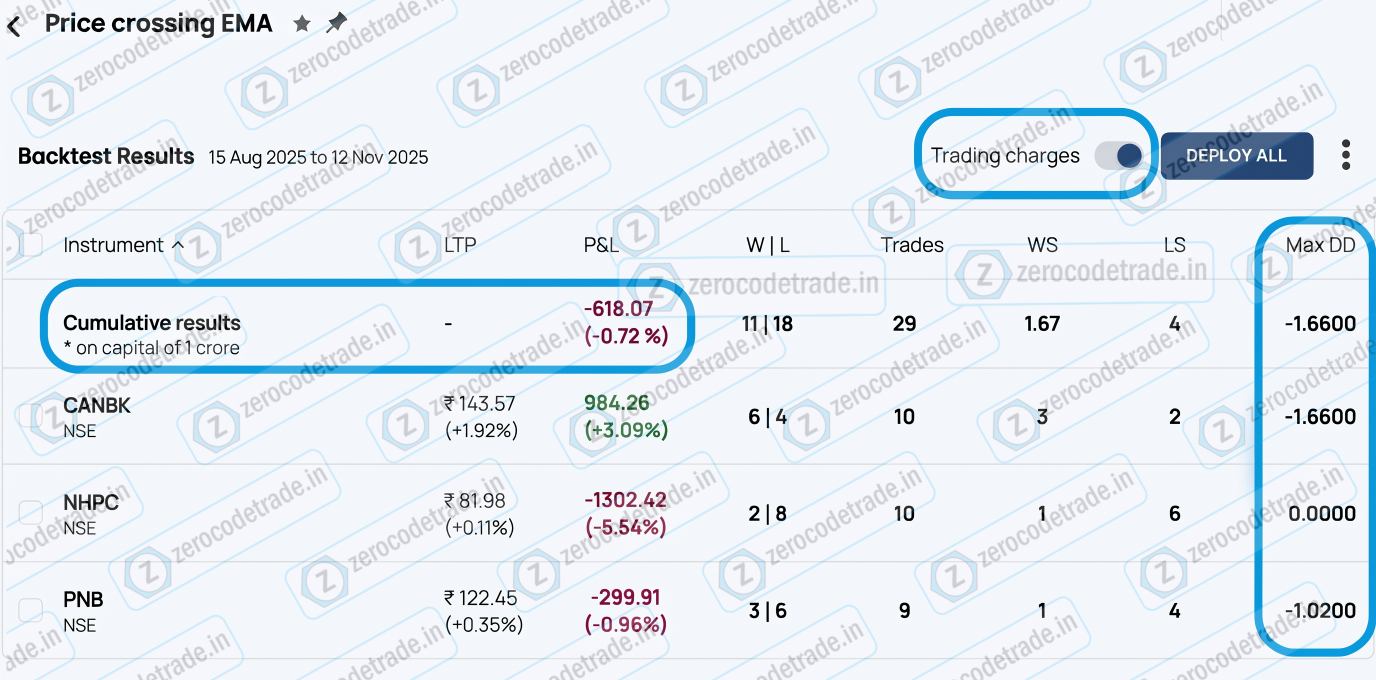
Even though the strategy logic looked strong, final backtest results were not impressive. This highlights an important lesson: A strategy that looks good on charts may still fail statistically.
You’ll often need to tweak:
- RSI thresholds
- Timeframes
- Stop-loss levels
- Stock universe
before deploying live. If you’re wondering whether indicator-driven bots are worth the capital, read our comparison on Cost of Algo vs. AI Trading: Why Should you Start with Rule-Based Bots.
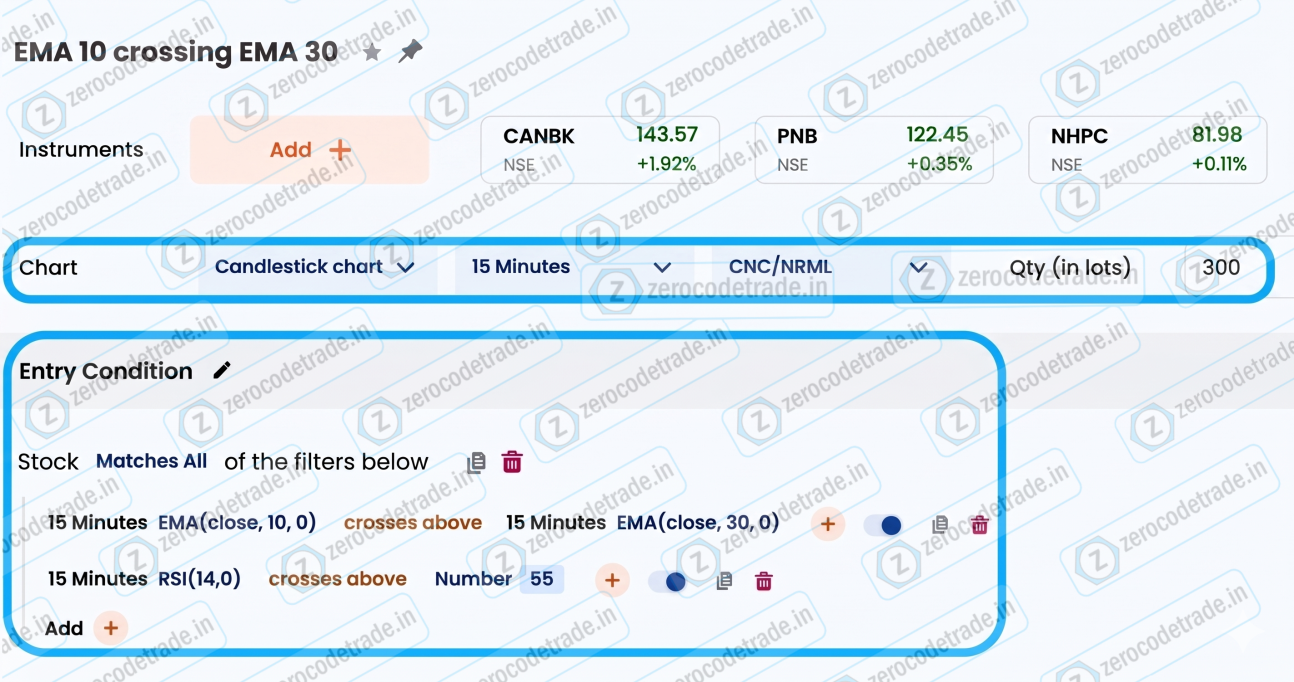
Swing Trading Strategy for Zerodha Streak (Trend-Following Crossover)
- Goal: Catch 3–7 day trends in strong stocks, both up and down.
- Type: Medium-term (2–7 days)
Strategy Rules:
- Buy Condition:
- 10-day EMA crosses above 30-day EMA
- AND RSI (14) > 55
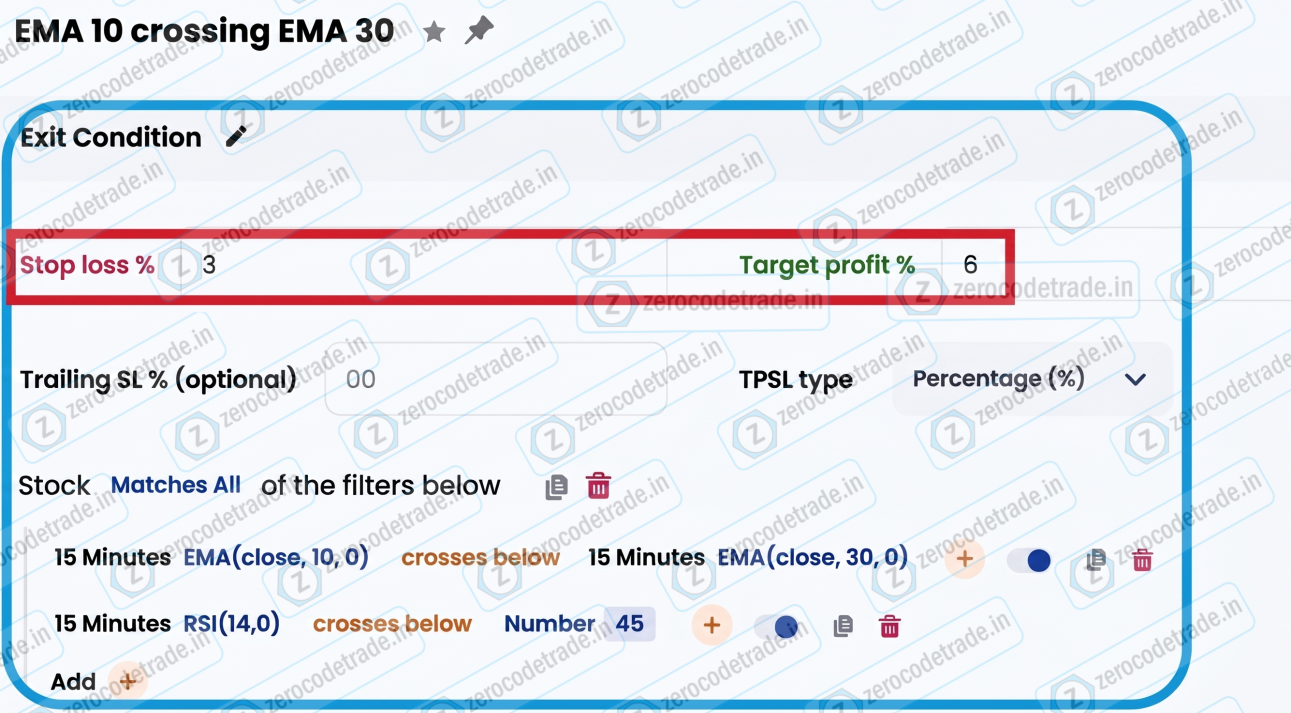
- Sell Condition:
- 10-day EMA crosses below 30-day EMA
- OR RSI (14) < 45
- Stop Loss: 3%
- Target Profit: 6%
- Time Frame: 1-hour or Daily
- Stocks Universe: NIFTY 200 or user watchlist of trending stocks
Why it works:
The moving average crossover identifies when a short-term trend shifts direction. The RSI filter confirms strength to avoid false crossovers in sideways markets. This strategy can hold positions for multiple days—ideal for swing traders. To understand how RSI strategies stack up against complex bots, see our article: Is RSI Algo Trading Better Than AI Bots?.
Optional Volume Filter (Highly Recommended)
Add this line to make either strategy stronger:
- Volume (today) greater than average volume(5 days)
This ensures you only enter when there’s genuine participation—not low-volume spikes.
Pro Tips for Using Zerodha Streak BTST & Swing Trading Strategies Effectively
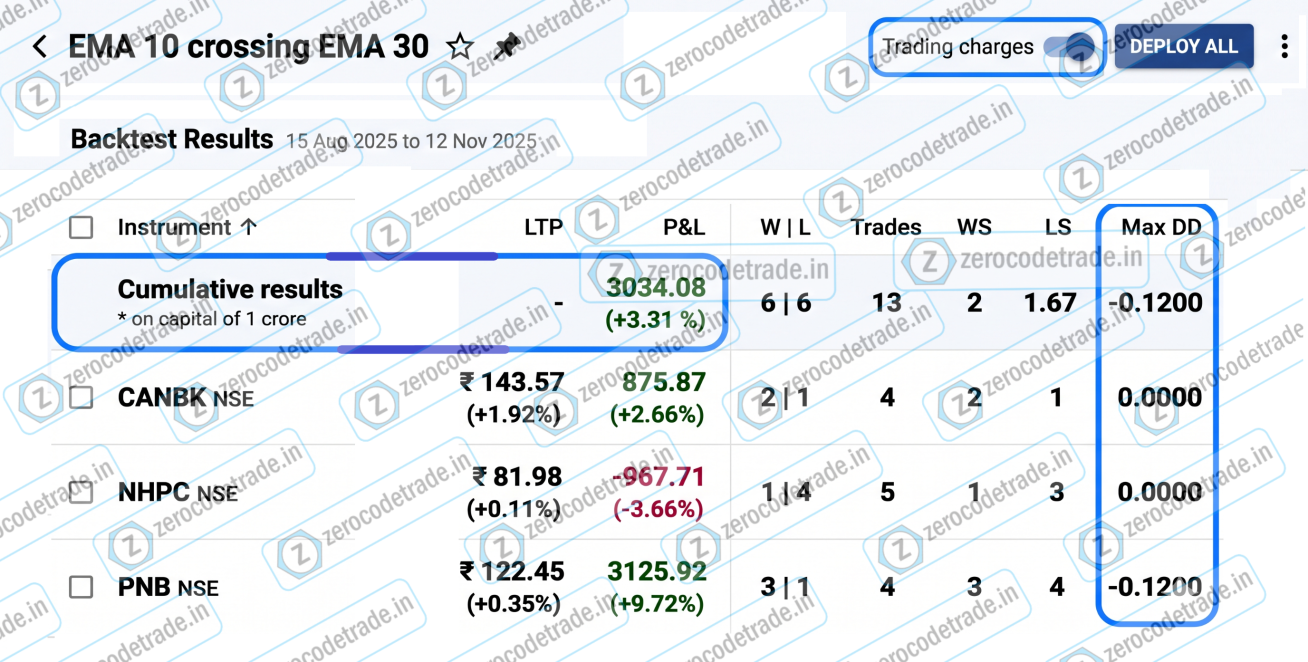
- Backtest Before Deploying: Always backtest across at least 6 months of data and multiple stocks. Focus on consistency, not just high returns.
- Avoid Penny Stocks: Stick to liquid names like those in NIFTY 200—illiquid ones have severe slippage issues.
- Check News Events: BTST positions are risky before earnings reports or major economic announcements—avoid trading those days.
- Combine with Scanners: Use Streak’s “Scanner” feature to filter stocks showing momentum conditions before deploying the strategy.
- Paper Trade First: Run your Zerodha Streak BTST & Swing Trading Strategies in paper mode for a few weeks to gain confidence before committing real funds.
Always backtest and verify your results thoroughly before going live, as shown in the screenshot examples above.
Comparison: Pre-Built vs Custom Streak Strategies
Pre-Built Strategies
Pros:
- Easy to deploy instantly
- Good for learning indicator logic
- Useful as a starting framework
Cons:
- Generic rules
- Not optimized for changing market conditions
- Often require customization to perform well
Custom-Created Strategies
Pros:
- Tailored to your specific risk appetite
- Better alignment with BTST or swing objectives
- Greater control over entries and exits
Cons:
- Requires testing and refinement
- Initial learning curve
Best approach: Use pre-built strategies for idea generation, then convert them into custom Zerodha Streak BTST & Swing Trading Strategies with optimized parameters.
Frequently Asked Questions (FAQs)
1. Are pre-built strategies in Zerodha Streak profitable for BTST and swing trading?
Pre-built strategies can be a good starting point, but profitability depends on market conditions, timeframe selection, and risk management. Most traders use them as a base and tweak parameters after backtesting rather than deploying them as-is.
2. Which timeframe works best for Zerodha Streak BTST & Swing Trading Strategies?
For BTST trading, hourly charts usually work better than very short timeframes. They help reduce market noise and generate more reliable overnight signals compared to 5-minute or 15-minute charts.
3. Can Zerodha Streak place trades automatically?
No. Zerodha Streak provides strategy alerts and signals, but traders must manually place or confirm orders via one-click notifications. Fully automated retail trading is currently restricted under Indian regulations.
4. How much historical data should I use for backtesting?
Ideally, you should backtest over at least 6 months to 1 year of historical data across multiple stocks. This helps evaluate how the strategy performs in different market regimes, not just during strong bull runs.
5. Is Zerodha Streak suitable for beginners?
Yes. Streak is beginner-friendly because it requires no coding and offers visual strategy building. However, beginners should start with paper trading and simple indicator combinations before risking real capital.
Conclusion
While no algorithm can guarantee profits, these two setups—EMA + RSI breakout for BTST and EMA crossover for swing trading—are among the most time-tested and beginner-friendly Zerodha Streak BTST & Swing Trading Strategies.
They work because they rely on clear, mechanical logic, don’t need frequent manual tweaking, and capture short-term market momentum effectively. Start small, use strict risk control, and remember: consistency > excitement. Algo trading is not about hitting home runs—it’s about letting logic, discipline, and data work quietly in your favor.
Disclaimer
We are here to help you navigate the complex world of 2026 trading technology. While we provide insights on Algo trading, AI trading, AI tools, indicators, platforms, and suggestions, please understand that this is not financial advice, nor is it a recommendation to trade.
Trading involves significant financial risk. Automated tools are meant to assist your workflow, but they do not guarantee profits or provide a “magic button” for income. Always Backtest, Paper Trade, and Start Small to protect your capital.
Limitation of Liability: Zerocodetrade.in and its authors are not responsible for any financial losses, damages, or missed profits that may result from the use of the content, strategies, or third-party tools mentioned in this blog. All trading decisions are made at your own risk.

“Written by Laxmi Narayan — A stock trader since 2021, he has focused on merging traditional technical analysis with modern tools like Grok AI, ChatGPT to simplify and to educate about various trading patterns and styles, Laxmi shares his knowledge and insights for educational and informational purposes only.”