
Algo vs. AI Trading: Which No-Code Automation Tool is Best for Retail Traders?
In 2026, the Algo vs AI trading debate is essential for retail investors looking to automate without coding. While traditional algorithmic systems follow fixed rules, modern artificial intelligence adapts to shifting markets. Understanding the nuance of Algo vs AI trading helps you choose the right no-code platform to revolutionize your strategy, ensuring your technical setup remains competitive in today’s fast-paced financial landscape.
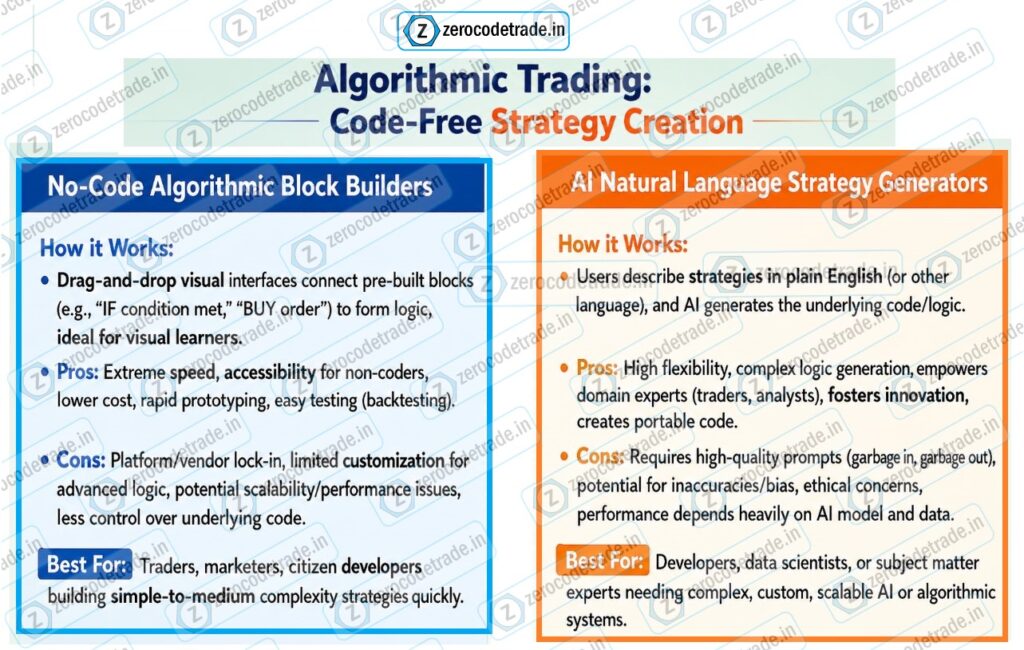
Which no-code tool is best: Algo vs AI Trading?
For retail traders in 2026, the best choice depends on strategy complexity. Algo Trading tools are best for executing fixed, “White-Box” rules like RSI or Moving Averages. AI Trading tools are best for traders seeking “Black-Box” adaptability, using natural language to build strategies that learn from market sentiment.
Choosing between these two depends heavily on your goals. For instance, if you are just starting out, you might want to read our How to trade stocks using Grok AI: A Beginners Guide 2026 to see how conversational AI can assist your research before you automate.
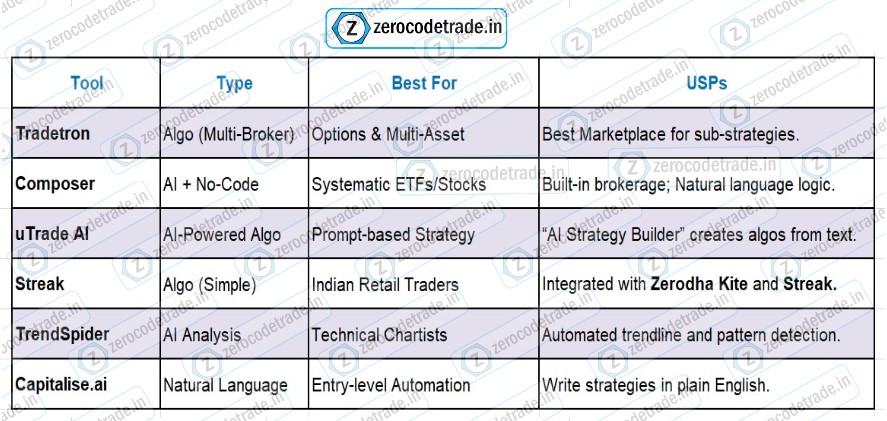
Algo Trading tools (like Tradetron or Streak) are best for executing fixed rules. However, many beginners find that Algo Trading vs. AI Trading Costs are a major factor; rule-based bots are often more affordable for those just starting their automation journey.
📺 Watch our Video explaining which Automation is best for Retail Traders:
Author’s Advice & Important Risk Note
- Stock and options trading are high-risk endeavours that can result in significant financial loss. Before committing real capital to the live market, it is essential to start with backtesting,forward testing, paper trading to validate your strategy.
- Do not blindly trust any single broker, platform, influencer, or social media channel. The trading landscape is full of noise; your priority should be mastering the basics of market mechanics at your own pace.
- The insights shared on this website—including our analysis are for informational and educational purposes only.
- We are not SEBI-registered advisors, and this content is not a recommendation to trade.
- Always perform your own independent research, testing before go live trading.
1. The No-Code Revolution of 2026
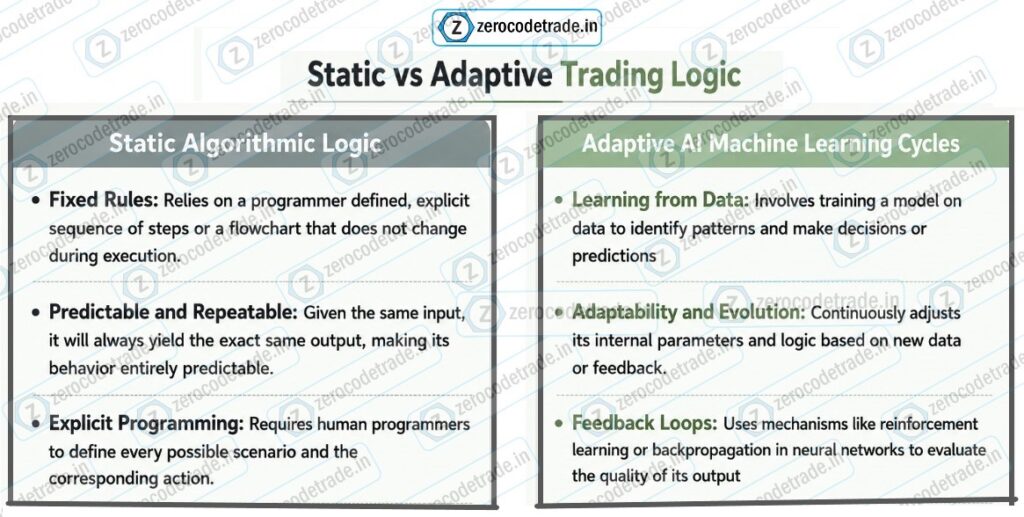
The year 2026 marks the end of the “Coding Barrier.” Retail traders no longer need to learn Python or MQL5 to compete with Wall Street. The rise of No-Code Automation has democratized systematic trading, but it has also created a new dilemma in the Algo vs AI trading landscape: Do you want a machine that follows your rules (Algo), or a machine that creates its own (AI)?
The Rise of the “Prompt-to-Trade” Model
In 2026, the most significant shift is the “Natural Language” interface. Tools now allow you to type: “Buy 100 shares of NVDA if the sentiment on X is bullish and the price is above the VWAP.” The tool then builds the logic in the background. This is the new standard for retail accessibility.
2. Algo vs. AI Trading: Defining the Tech Stack
2.1 Algorithmic Trading (Rule-Based)
Algorithmic trading is Deterministic. It follows a strict “If-Then” logic. It is essential to understand Manual vs Algo trading the critical difference before you automate, as the logic remains the same—only the execution speed changes.
- Example: “If RSI < 30, then BUY.”
- Best for: Discipline, backtesting accuracy, and transparency.
2.2 AI Trading (Machine Learning)
AI Trading is Probabilistic. It doesn’t just follow rules; it identifies patterns.
- Example: “Based on the last 10,000 trades and current news, there is a 72% probability of an upside move.”
- Best for: Volatile markets, sentiment analysis, and multi-factor strategies.
3. Top No-Code Tools Comparison Table 2026
4. Deep Dive: Why Retail Traders Prefer No-Code
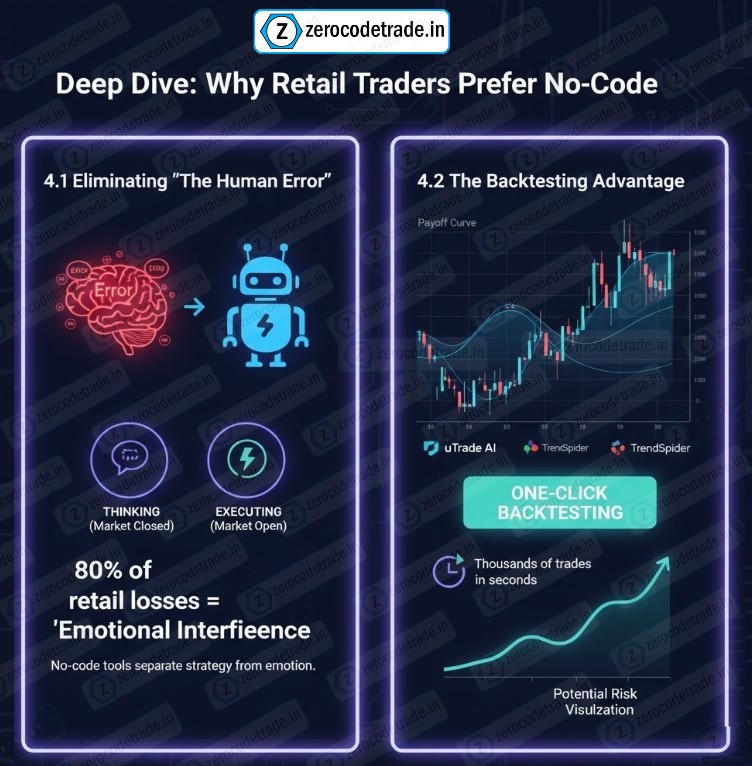
4.1 Eliminating “The Human Error”
By 2026, data shows that over 80% of retail losses are attributed to “Emotional Interference.” No-code tools allow a trader to do the “thinking” while the market is closed. If you are using a modern broker like Dhan, you can plug these tools directly into your account for seamless execution.
4.2 The Backtesting Advantage
In the past, backtesting required manual data entry. In 2026, no-code tools like uTrade AI and TrendSpider offer “One-Click Backtesting” that simulates thousands of trades in seconds, providing a “Payoff Curve” to visualize potential risk.
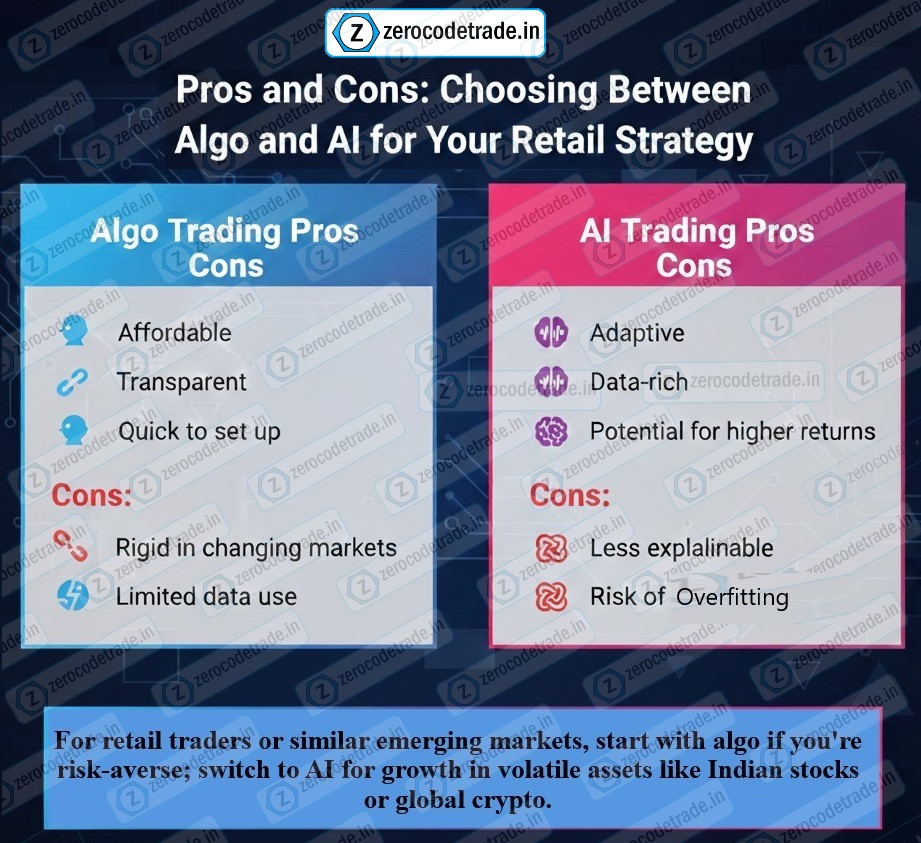
5. Pros and Cons: Choosing Between Algo and AI trading for your Retail Strategy
Algo Trading
Pros: Affordable, transparent, quick to set up.
Cons: Rigid in changing markets, limited data use.
AI Trading
Pros: Adaptive, data-rich, potential for higher returns.
Cons: Higher costs, less explainable, risk of “over fitting”.
For retail traders or similar emerging markets, start with algo if you’re risk-averse; switch to AI for growth in volatile assets like Indian stocks or global crypto.
Which No-Code Tool Wins for Retail Traders in 2026?
In the Algo vs AI trading battle, the winner depends on your risk appetite. For simplicity and low-risk entry, go with no-code algo tools like Composer or uTrade Algos. If you want cutting-edge performance in complex markets, AI bots like Nvestiq or StockHero edge out. Hybrid platforms (e.g., TrendSpider) offer the best of both.
In 2026, with AI adoption surging, many retail traders blend them—use algo for core rules and AI for optimization. Test with demo accounts to avoid losses.
Advanced Trading Tips for 2026
- The Hybrid Approach: Use AI (like Grok or ChatGPT-4o) to generate the “Idea” and use an Algo Tool (like Tradetron) to execute it. This keeps you in control of the final “Buy” signal.
- Avoid “Overfitting”: Don’t make your AI strategy too specific to last year data. Markets in 2026 move faster; a strategy that worked last year might “hallucinate” in today’s volatility.
- Paper Trade for 2 Weeks: No matter how good the AI sounds, always run it in a “Simulated” environment for 14 days before using real capital.
Frequently Asked Questions (FAQ)
General Questions
1. Is no-code trading legal?
Yes, as long as you use exchange-approved platforms and follow local regulations (like SEBI in India or FINRA in the US).
2. Do I need a VPS?
Most 2026 tools are “Cloud-Based,” meaning they run on the company’s servers. You don’t need to keep your computer on.
3. Can I trade Crypto with these?
Yes, platforms like Kryll.io and Composer have extensive Crypto support.
Advanced “Pro” FAQs
1. What is “Model Drift” in AI trading?
This happens when an AI’s accuracy degrades as the market environment changes. Successful 2026 traders “Retrain” their models monthly.
2. Can I combine Sentiment Analysis with RSI?
Yes. Modern no-code tools allow you to use “Sentiment Score” as a filter. If Sentiment is < 50, the bot won’t take the trade even if the RSI says “Buy.”
3. What is “Latency” in retail automation?
Latency is the delay between the signal and execution. In 2026, look for “Server-side execution” to minimize this.
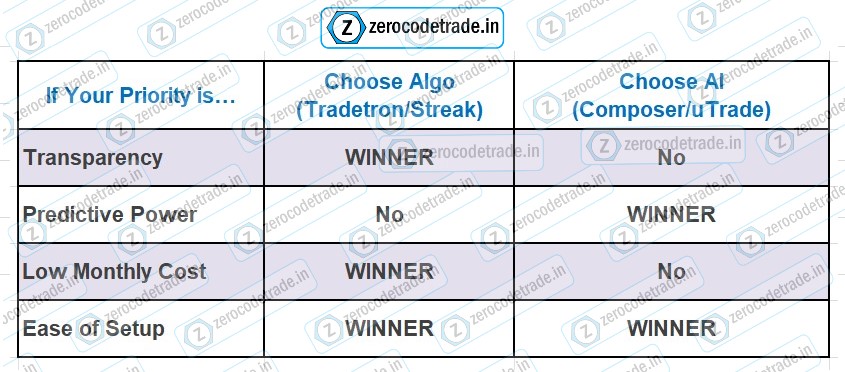
Summary Table: Your Decision Matrix
Conclusion:
In the battle of Algo vs. AI trading, there is no single “Best” tool—its only best tool for your specific strategy.
- Choose Algo if you have a proven strategy (like a Gap-Up or Mean Reversion) and simply want a machine to execute it without emotion.
- Choose AI if you want to explore complex, non-linear relationships in data that the human eye cannot catch.
The future of trading is not just automated; it’s intelligent.
Disclaimer
We are here to help you navigate the complex world of 2026 trading technology. While we provide insights on Algo vs AI trading platforms and suggestions on which no-code platforms and AI tools are currently leading the market, please understand that this is not financial advice, nor is it a recommendation to trade.
Trading involves significant financial risk. Automated tools are meant to assist your workflow, but they do not guarantee profits or provide a “magic button” for income. Always Backtest, Paper Trade, and Start Small to protect your capital.
Limitation of Liability:The Zerocodetrade.in and its authors are not responsible for any financial losses, damages, or missed profits that may result from the use of the content, strategies, or third-party tools mentioned in this blog. All trading decisions are made at your own risk.

“Written by Laxmi Narayan — A stock trader since 2021, he has focused on merging traditional technical analysis with modern tools like Grok AI, ChatGPT to simplify and to educate about various trading patterns and styles, Laxmi shares his knowledge and insights for educational and informational purposes only.”